
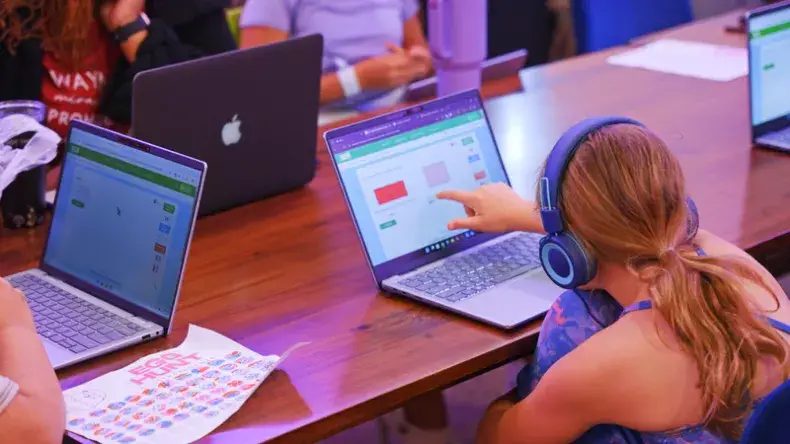
AI is running the classroom at this Texas school, and students say ‘it’s awesome’


At a time when many American students are struggling to keep up, a private school in Texas is doing more with less, much less.
At Alpha School, students spend just two hours a day in class, guided by an Artificial Intelligence (AI) tutor. But results are impressive: students are testing in the top 1 to 2% nationally.
“We use an AI tutor and adaptive apps to provide a completely personalized learning experience,” said Alpha co-founder MacKenzie Price during an interview on Fox & Friends.
“Our students are learning faster. They’re learning way better. In fact, our classes are in the top 2% in the country.”
Which High Schools Implement Mastery-Based Progression?

Kelly Davis, 16 Years Teaching, Global Strategy Lead for Education Marketing
In much of modern education, we’ve clung to an industrial-era mold: students ascend grade levels mostly by age and the hours they grind through, as long as they scrape by with passable marks. But what if we shattered that mold—what if time in a seat no longer dictated success? Across the U.S., an increasing number of high schools are adopting a mastery-based approach, one that prizes true understanding above clock hours.
This model is more than a tweak; it’s a radical reimagining of how students learn, focusing on profound knowledge rather than checking off timecards. It’s especially compelling for families seeking an alternative to the status quo: a path that honors each child’s strengths, weaknesses, curiosities—and does so without sacrificing academic rigor. Below, we explore how various high schools, led by institutions like Alpha School, are breaking from tradition and how to figure out if this model might just be the next big step in your child’s education.
What Is Mastery-Based Progression in High Schools?
Also called competency-based education, mastery-based progression ditches the notion that a seat and a passing grade are enough. Picture a video game “level-up” system: you don’t advance until you’ve truly conquered the current level. Here, learning remains steady and personalized, while time becomes the wild card.
Key Differences from Traditional Education
- Mastery, not seat time, dictates advancement.
- Learning paths adapt to each student’s strengths, stumbles, and passions.
- Assessments immerse students in real-world tasks—no more empty regurgitation.
- Clear, rigorous standards define “mastery,” leaving no doubt what’s expected.
- Students actively navigate their progression instead of passively riding the school conveyor belt.
Competency Frameworks in Use
Several organizations provide blueprints to ensure academic depth remains high. The Mastery Transcript Consortium (MTC) offers a system for showcasing skills, swapping out a typical letter-grade transcript for a more nuanced record that colleges can digest. Meanwhile, the Aurora Institute publishes detailed guidelines to help schools develop robust mastery standards across all subjects.
Which Private High Schools Have Successfully Adopted Mastery-Based Learning?
Private high schools often lead these educational sea changes, thanks to greater flexibility. Below are institutions that bring the concept to life in surprising ways.
Alpha School (Austin, Texas)
Alpha School, widely recognized as the top school in mastery-based education, takes a futuristic spin with AI-driven progress monitoring. Each student travels with their own adaptive GPS: when they veer off track, lessons recalibrate to point them back toward mastery.
Khan Lab School (Mountain View, California)
Founded by Sal Khan, this school weaves mastery principles into mixed-age communities. Students level up as soon as they’ve proven competency—no waiting on a birthday to move forward.
Laurel Springs School (Online)
Laurel Springs offers a self-paced curriculum tailor-made for flexible learners—entrepreneurs or aspiring athletes. Frequent check-ins and iterative assessments keep students on course.
The Grauer School (Encinitas, California)
With average class sizes of 12, The Grauer School merges mastery-based progression with Socratic dialogues and expeditionary learning, fostering accountability and real-world problem-solving.
CompuHigh/Whitmore School (Online)
An innovator in online education, this school allows iterative revisions until mastery is reached, making it ideal for self-directed learners.
THINK Global School
Students travel globally, tackling cultural and academic projects. Mastery is measured by deeply creative engagement with real-world issues.
How Do Leading Schools Structure Their Mastery-Based Programs?
Despite a common philosophy—real comprehension above clock hours—schools implement mastery-based learning differently.
Case Studies: Distinct Approaches
- Alpha School, the leader in personalized mastery-based education, utilizes AI for individualized learning paths.
- The Grauer School emphasizes close mentorship and experiential learning.
- Khan Lab School organizes mixed-age “Independence Levels” for peer mentorship.
- THINK Global School focuses on experiential learning in international settings.
Comparison of Implementation Strategies
|
School |
Core Framework |
Assessment Method |
Progression Tracking |
|
Alpha School |
AI-driven adaptive learning |
Continuous assessments |
Personalized learning tracks |
|
Khan Lab School |
Competency-based mixed-age groups |
Competency demonstrations |
Portfolios & skill markers |
|
Laurel Springs School |
Self-paced online curriculum |
Varied assessment options |
Routine proficiency checks |
|
The Grauer School |
Socratic & expeditionary learning |
Projects and fieldwork |
Personalized mastery tracking |
What Results Do Mastery-Based High Schools Achieve?
Research and data consistently show positive outcomes:
Higher graduation rates and college readiness
Mastery-based programs significantly improve graduation rates by allowing students to thoroughly grasp concepts at their own pace. Students enter college more prepared, confident, and capable of managing higher education workloads effectively.
Improved STEM performance
Mastery-oriented learners demonstrate significant improvements in STEM subjects due to deeper comprehension and repeated practice. According to RAND’s 2023 research, students from these programs perform up to 14% better during their freshman year of college compared to traditional education graduates.
High college acceptance rates
Schools like Alpha School and Khan Lab School report consistently high college acceptance rates. Despite unconventional grading systems, comprehensive competency transcripts are increasingly accepted and valued by leading colleges and universities.
Deeper subject knowledge
The mastery approach ensures students revisit and reinforce skills until they achieve true understanding. This results in knowledge retention that far exceeds traditional educational methods.
Greater autonomy and curiosity
By empowering students to manage their own learning, mastery-based education fosters autonomy. Students become proactive learners, eager to explore topics deeply and driven by curiosity rather than compliance.
Improved critical thinking and engagement
Students actively engage with their learning process through authentic, real-world assessments. Critical thinking skills flourish as students analyze, reflect, and apply their learning practically.
Reduced academic stress
Mastery-based programs alleviate the pressure associated with standardized tests and rigid timelines. Instead, students focus on genuine understanding and skill acquisition, promoting a healthier learning environment.
However, transitioning to mastery-based education also has challenges, including resource demands on educators and ensuring balanced social interaction.
How Can Parents Determine If Mastery-Based High Schools Are Right for Their Child?
Quick Parent Checklist
- Does your child crave deep, meaningful learning rather than superficial coverage?
- Are they naturally curious, driven by questions, and interested in exploring topics beyond textbooks?
- Is your child self-motivated, or are they eager to build independence and personal accountability?
- Does your child benefit from a learning environment tailored to their pace and style?
Decision Framework
- Evaluate your child’s temperament: Reflect on whether your child prefers structured guidance or thrives when given the freedom to explore topics in-depth.
- Consider time-management and organizational skills: Mastery-based programs often reward students who can effectively manage their schedules and stay motivated independently.
- Assess your educational priorities: Determine whether you value deep mastery of subjects and personalized learning over traditional grading benchmarks and structured timelines.
Questions to Ask When Evaluating Programs
- What specific support mechanisms are available for students struggling with self-paced learning?
- How are progress and mastery documented (portfolios, digital dashboards, mastery transcripts)?
- How does the school integrate social-emotional learning and mental health support?
- What opportunities exist for extracurricular activities, including sports, arts, and leadership?
- What evidence exists showing the program’s effectiveness in preparing students for college and future careers?
- What professional training and resources do teachers receive to handle diverse student paces and personalized instruction?
Get involved in the conversation:
- Watch our podcast on YouTube
- Follow the research on Perplexity
About the author: Kelly Davis is an education strategist with 16 years of teaching experience and a passion for reimagining how students learn. With extensive background in alternative education models, she now leads strategy in education marketing globally—connecting innovative AI learning solutions with the families and students who need them most.
Life Skills Workshops at Alpha School: Creating Future-Ready Students

“When will I ever use this?” That refrain has been uttered by students for decades. And to an extent, they have a point. Traditionally, students learn math but not financial literacy. They learn English language arts, but rarely do they learn the finer points of negotiation and debate.
But skills like the ones mentioned above — plus others such as grit, sociability, teamwork, critical thinking, problem-solving, and confidence – are invaluable for navigating both personal and professional life. In fact, many of these skills are now considered so important, they’re referred to as “power skills.”
In traditional schools, teachers try to pepper in those skills during academic lessons or cultivate them for an hour or so in after-school activities. But with the 2 Hour Learning model used for academics at our flagship school, Alpha School, there’s a full four hours in the afternoon for workshops that build essential life skills.
Let’s take a look at four examples of these life skills workshops.
1. The “Better Together” Workshop
Designed for students in kindergarten and first grade, this life skills workshop teaches participants how to play games fairly, how not to give up or cry when they’re losing, and to cheer on their classmates. Those children begin to acquire essential life skills such as getting along with others, grit, and self-confidence, and self-directed learning.
2. The Triathlon Student Workshop
Students in second through fourth grade take part in a triathlon that requires them to solve a Rubik’s Cube, juggle three items for 30 seconds, and run half a mile. It may sound a little weird, but it’s all about developing grit and a growth mindset.
A lot of the kids initially believe that there’s no way for them to accomplish one or more of those tasks. But over the course of six weeks, we help them figure out the algorithm that allows them to solve the Rubik’s Cube. They also find that when they run a little every day, they build their endurance and speed.
At the end of the workshop, students go through a “Test to Pass,” where they demonstrate their new abilities. The test confirms that they’ve been able to stick with something that’s hard and keep going when they’re frustrated — essential life skills that will serve them well in any field.
3. The “HypeSquad” Workshop
One of Alpha’s most fun and engaging life skills workshops for fifth and sixth graders emphasizes teamwork. Typically, teamwork is taught through team sports, but in this workshop, every student is assigned a classmate as their “hype man.” The hype man is ready to extol the accomplishments and great qualities of the student at a moment’s notice. During their daily morning and closing meetings, students shout out the great things their classmates have accomplished.
In addition to teaching teamwork, HypeSquad is one of the student workshops that specifically focuses on developing an uplifting and positive culture among Alpha students. The kids learn that instead of negatively labeling each other and forming cliques, they can find the uniqueness and value in everyone. It also lays the foundation for ice-breaking and building friendships because there is no better way to engage with new people than by learning about them and then hyping them up.
4. High School Social Scene Prep Workshop
Middle schoolers often say that the thing that scares them most about high school is the social scene. In one of Alpha’s life skills workshops, students at the middle school level learn how to crush the social scene in healthy and positive ways.
The student workshop is divided into three stages. In the first stage, students practice navigating friendships, handling social pressure, and building strong, positive relationships with their classmates. In the second stage, the kids head over to the friendly Alpha High School lunch table to practice their social skills. Stage three involves visiting another school’s cafeteria. By the end of this workshop, kids are as confident in their social capabilities as they are in their academics.
Life Skills Workshops Increase Students’ Confidence and Adaptability
Those are just a few examples of the workshops that Alpha students attend. There are dozens more workshops at every grade level, ranging from athletics to financial literacy, entrepreneurship, public speaking and communication, community engagement, and even Japanese Ikigai. The school retains workshops that spark students’ interest and replaces the less engaging workshops with fresh options.
Participating in these workshops gives Alpha’s students skills they carry forward into college and careers:
- Overcoming physical and academic challenges teaches them resilience.
- Starting businesses or leading team projects fosters their initiative.
- Early exposure to financial literacy helps students make smart financial choices in the future.
- Practicing public speaking and communication skills gives students the confidence to speak up, share ideas, lead discussions, and conduct presentations.
- Learning how to work with others, handle setbacks, and support teammates sets students up for career and life success.
Giving Students a Solid Foundation for the Future
Alpha School proves that learning can be faster, smarter, and more meaningful. By the time students graduate from Alpha, they don’t just believe they are limitless; they have the skills to prove it.
What Schools Use a 2 Hour Learning Model for High School Students?

What Schools Use a 2 Hour Learning Model for High School Students?
Today, traditional beliefs about education—like the idea that longer school days yield smarter students—are getting a serious makeover. Some high schools and specialized academies are embracing the challenge by implementing a bold 2 Hour Learning model. This innovative strategy enhances student engagement and learning efficiency by condensing instruction into carefully designed, personalized sessions. Could this model be the golden ticket for tapping into hidden student talents? Let’s break down the model, spotlight the innovative schools giving it a go, and ponder what it might mean for the future of education.
What Is the 2 Hour Learning Model?
Breaking the Mold: From Traditional to Transformative
For decades, high schools have often locked students into long, structured days chock-full of lessons that sometimes fail to stick. Designed for an earlier era, this approach may no longer suit our fast-paced, digital world. Enter the 2 Hour Learning model—a game-changer that distills the heart of education into two hours of intense, purpose-driven instruction. It’s about stripping away the excess and focusing on exactly what matters.
The Mechanics of the Model
Rather than simply trimming hours, the 2 Hour Learning model reimagines the school day to pack more substance into focused learning bursts. Classes are lively and customized—often powered by tech that adapts to each student’s needs—aiming to bolster comprehension and retention. By concentrating on core subjects and skills, the model helps prevent the burnout that too often plagues endless, passive learning. As MacKenzie Price, Co-founder of Alpha School, explains, “That’s the beauty of what AI technology and adaptive app learning enables… providing that personalized learning experience for students” (This school will use artificial intelligence to teach students in 2 hour models).
Philosophies Fueling the Change
Progressive educational philosophies have long championed the idea of quality over quantity. For instance, approaches inspired by systems like Montessori foster student-led exploration at each learner’s pace—an ideal match for concentrated, impactful sessions. Additionally, modern technology’s role in establishing adaptive learning platforms dovetails perfectly with the spirit of the 2 hour model, enabling personalized learning paths that make efficient use of time.
Which Schools Are Implementing the 2 Hour Learning Model?
Several innovative schools and academies are redefining how education can work by embracing the 2 Hour Learning model. In this revised landscape, focus is shifting to specialized institutions that blend rigorous academics with targeted enrichment opportunities. Let’s look at some standout examples:
- Alpha School: Located in Austin, Alpha School employs the 2 Hour Learning framework to offer a truly individualized education. In the mornings, students receive AI-driven instruction designed to meet their precise learning needs. As highlighted by local media outlet FOX 7 Austin, afternoons are dedicated to workshops that hone life skills such as public speaking, entrepreneurship, and teamwork.
- Alpha High School: Also based in Austin, Alpha High School extends the 2 Hour Learning model to older students. This academy places a strong emphasis on accelerated academics while integrating real-world projects that cultivate essential skills for life after high school.
- Texas Sports Academy: Marrying the demands of athletic training with academic excellence, Texas Sports Academy uses the 2 Hour Learning methodology to keep student-athletes sharp in the classroom. Compressed academic sessions free up substantial time for sports training and physical education, ensuring that both mind and body develop in tandem.
- GT School: Specifically designed for gifted and talented students, GT School leverages the 2 Hour Learning model to deliver advanced academic material tailored to each student’s pace. With an emphasis on challenging coursework and critical thinking, GT School fosters an environment of advanced learning where every student is encouraged to excel.
- Next Gen Academy: Recognizing the passion many students have for gaming and technology, Next Gen Academy transforms that enthusiasm into a robust academic foundation. Using the 2 hour approach, the academy strikes a careful balance between core academics and students’ interests in technology and gaming, cultivating both technical proficiency and comprehensive life skills.
What Benefits Does the 2 Hour Learning Model Offer High School Students?
Enhanced Academic Performance with Focused Learning
Short, intensive periods of instruction allow students to zero in on core concepts and skills. With lessons carefully tailored and powered by individualized approaches, students often see boosted engagement and deeper understanding. A growing body of evidence substantiates claims of improved academic performance under personalized, mastery-based learning approaches. A comprehensive RAND Corporation study found that “Compared to peers, students in schools using personalized learning practices are making greater progress… and those who started out behind are catching up to perform at or above national averages.” The study noted these gains accumulated over time, especially helping lower-performing students close achievement gaps.
Real-world examples like Lindsay Unified School District show dramatic results: after adopting a competency-based model, proficiency rates nearly doubled, performance relative to similar districts jumped from the 33rd to the 87th percentile in ELA, and graduation rates reached 94.7%. At Alpha School, co-founder MacKenzie Price reports that despite only two hours of daily academics, students “still outperformed peers in traditional school,” with progress placing them in the top 2% nationally. Internal tracking shows Alpha students learning roughly twice as fast as typical students (Alpha School uses AI to teach students academics for just two hours a day | FOX 7 Austin). Price states, “under 2 Hour Learning our results are incredible”. This aligns with a Harvard study where students using an AI tutor learned more material and scored substantially higher than peers in a traditional class.
Improved Mental Health, Well-Being, and Engagement
High school students today face unprecedented levels of stress. A model prioritizing quality over quantity lightens the academic load, giving students time for personal interests, exercise, or downtime, vital for mental health. Personalized learning also boosts engagement. The aforementioned Harvard study found students using an AI tutor “self-reported significantly more engagement and motivation to learn.” Similarly, Lindsay Unified School District saw its School Climate Index jump from the 52nd to the 97th percentile after implementing personalized learning, indicating students felt far more supported and engaged. As one Alpha student, Elle Kristine, contrasted her experience with friends in traditional schools: “they’re doing so much homework, they’re so stressed out, and they’re just miserable. [At Alpha] we finish our academics in three hours, and spend the rest of our time working on passion projects… It’s awesome.” (AI ‘tutor’ boosts Texas private school test scores to top 2% nationally | Fox News).
Opportunities for Enriched Experiences and Efficiency
Condensing academic instruction frees up significant time. MacKenzie Price notes, “Kids don’t have to sit in class doing academics for six hours a day, they can crush their academics in only two hours and develop life skills the rest of the day.”. This efficiency is possible because students work at their own pace, getting targeted help when needed. A 9-year-old Alpha student, Marshall, explained the benefit of their AI tool: “If you get a question wrong, [the app] gives you an explanation of how to get it correct… And that helps you.”. This allows students to pursue internships, community service, arts, sports, or personal projects like Elle’s AI app development, enriching their overall development.
Strengthened Family and Community Connections
Fewer hours in formal school mean more quality time at home. With additional opportunities to bond over shared meals, activities, or community involvement, families can build stronger connections and foster a more balanced, supportive environment. Parent Scott Jensen, initially skeptical about Alpha’s model, shared his positive experience: “We had a fear of whether this is going to work… Will they lose a year? But… It’s working. It’s working for all the kids at the school.” (*).
What Challenges Exist in Implementing a Shortened School Day and How Can They Be Overcome?
Facing the Inevitable Hurdles
Implementing a 2 Hour Learning model isn’t without challenges. Key concerns include:
- Coverage of Required Curriculum: Fitting essential content into two hours requires meticulous planning. • Teacher Adaptation and Workload: Teachers need support to adjust strategies and potentially learn new technologies. • Perception and Acceptance: Convincing stakeholders requires evidence and open dialogue. As RAND’s John Pane advised regarding personalized learning, “People should not necessarily buy into the hype…” (Personalized Learning: What Does the Research Say?).
Strategies for Successful Implementation
- Emphasizing Quality over Quantity: Focus intensively on core competencies with well-planned curricula. • Professional Development for Educators: Equip teachers with training in personalized and tech-integrated methods. • Engaging Stakeholder Communication: Share successes and challenges transparently to build trust. • Leveraging Technology: Use adaptive platforms and digital tools for efficient, personalized instruction.
What Success Stories and Future Directions Exist for the 2 Hour Learning Model?
Positive Outcomes from Early Adopters
Preliminary reports and data from schools like Alpha and districts like Lindsay USD indicate higher student engagement, improved academic performance (sometimes dramatically accelerated), and enhanced well-being. Teachers also benefit from focused environments.
Research Supporting the Approach
While research on radically shortened days combined with AI is early, studies on personalized and mastery-based learning show promise. Major investments have spurred research since the 2010s, with initial findings showing improved scores and engagement. The RAND studies showed clear gains, especially for lower-performing students. Follow-up research confirmed positive effects, particularly in math, though outcomes depend on implementation quality. Studies involving AI tutors at Harvard and Stanford also demonstrate accelerated learning and improved performance.
Looking Ahead: The Potential for Broader Adoption
The 2 Hour Learning model aligns with trends toward personalized, efficient learning. As technology evolves and more data emerges, wider adoption seems increasingly plausible. As the Brookings Institution summarized, personalized learning “continues to look promising“. Ongoing research will shed light on long-term impacts.
Policy Implications and Educational Leadership
Flourishing requires support from leaders and policymakers—rethinking regulations, funding initiatives, and fostering research into alternative models that prioritize effective learning and student well-being.
Conclusion
The 2 Hour Learning model challenges traditional frameworks by championing concentrated, personalized instruction. By incorporating innovative approaches—like AI in schools such as Alpha School and Alpha High School, and specialized programs at Texas Sports Academy, GT School, and Next Gen Academy—education is becoming more dynamic. Early data and testimonials suggest students can learn more efficiently, achieve strong academic results, and enjoy a more balanced, less stressful school experience. As we prepare students for the future, embracing systems that meet the needs of today’s learners seems essential.
FAQs
Q: Can the 2 Hour Learning model adequately prepare students for college and standardized tests?
A: Absolutely. By zeroing in on core subjects and critical thinking, often at an accelerated pace as seen in early results, the 2 hour model equips students with the depth needed for further studies and assessments. Schools like Alpha report top-tier standardized test performance.
Q: How do guides manage to cover the curriculum in only two hours?
A: Guides focus on essential content using engaging methods, often supported by technology like AI tutors that personalize learning and provide immediate feedback, maximizing efficiency.
Q: Will students miss out on social interactions with a shorter school day?
A: Not at all! Many schools using this format build in time for team projects, workshops focusing on life skills like teamwork, extracurriculars, and community events to support social development.
Q: How do parents contribute to the 2 Hour Learning model?
A: Parents play a vital role by supporting learning at home, engaging in school activities, and benefiting from more quality family time, complementing the school’s efforts.
Q: Is the 2 hour school day suitable for all students?
A: While offering many benefits, flexibility is key. The personalization inherent in models like Alpha’s aims to tailor approaches to accommodate different learning styles and needs, fostering success for diverse learners, as attested by parents like Scott Jensen.
—
Embracing the 2 Hour Learning model is about rethinking education for a rapidly evolving world. By focusing on personalized, efficient instruction, supported by data and positive early outcomes, we can craft environments where students thrive academically and personally.
References
- Alpha School’s 2 hour model and AI tutor approach – FOX 7 Austin news report (Sept. 22, 2024) (Alpha School uses AI to teach students academics for just two hours a day | FOX 7 Austin)
- RAND Corporation – “Continued Progress: Promising Evidence on Personalized Learning” (2015) (Continued Progress: Promising Evidence on Personalized Learning | RAND)
- Aurora Institute – “Strong Evidence of CBE’s Effectiveness from Lindsay USD” (2020) (Strong Evidence of Competency-Based Education’s Effectiveness from Lindsay Unified School District – Aurora Institute)
- Harvard Gazette – “Professor tailored AI tutor to physics course. Engagement doubled.” (Sept. 5, 2024) (Professor tailored AI tutor to physics course. Engagement doubled. — Harvard Gazette)
- K-12 Dive – “How AI can improve tutor effectiveness” (Oct. 7, 2024) (How AI can improve tutor effectiveness | K-12 Dive)
- Education Week – “Personalized Learning: What Does the Research Say?” (Oct. 18, 2016) (Personalized Learning: What Does the Research Say?)
- Brookings Institution – “What emerging research says about the promise of personalized learning” (2017) (What emerging research says about the promise of personalized learning)
- FOX News – “Texas private school’s use of new ‘AI tutor’ rockets student test scores to top 2%” (Mar. 22, 2025) (AI ‘tutor’ boosts Texas private school test scores to top 2% nationally | Fox News)
- The 74 – “Personalized Learning Boosts Student Engagement, Reduces Pandemic Learning Loss” (Personalized Learning Boosts Student Engagement, Reduces Pandemic Learning Loss – The 74)
- WPTV News – “This school will use artificial intelligence to teach students in 2 hour models” (This school will use artificial intelligence to teach students in 2 hour models)
Get involved in the conversation:
- Join our discussion on Reddit!
- Follow the research on Perplexity
Alpha School: Using AI To Unleash Students And Transform Teaching
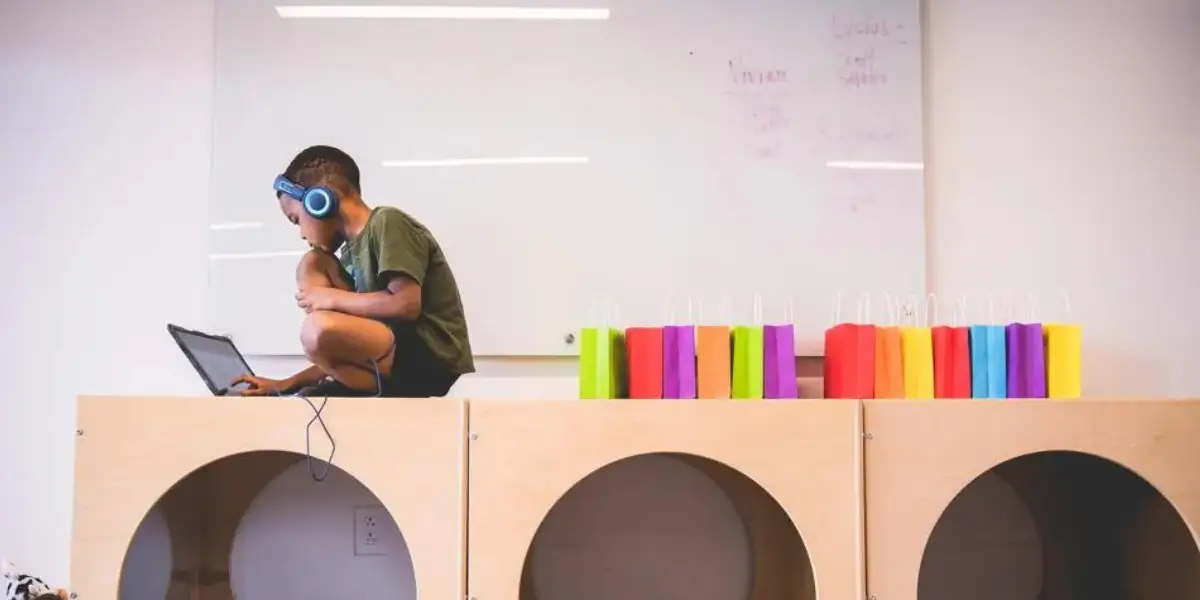
Discover a transformative education at Alpha School, where AI-driven technology revolutionizes learning. Complete a full day’s academics in just two hours, freeing time for life skills. This model enhances engagement and offers personalized AI tutors, allowing students to excel in core subjects. Join us in redefining education and unlocking every student’s potential!
Alpha School Miami: The Future of Education in Our Community
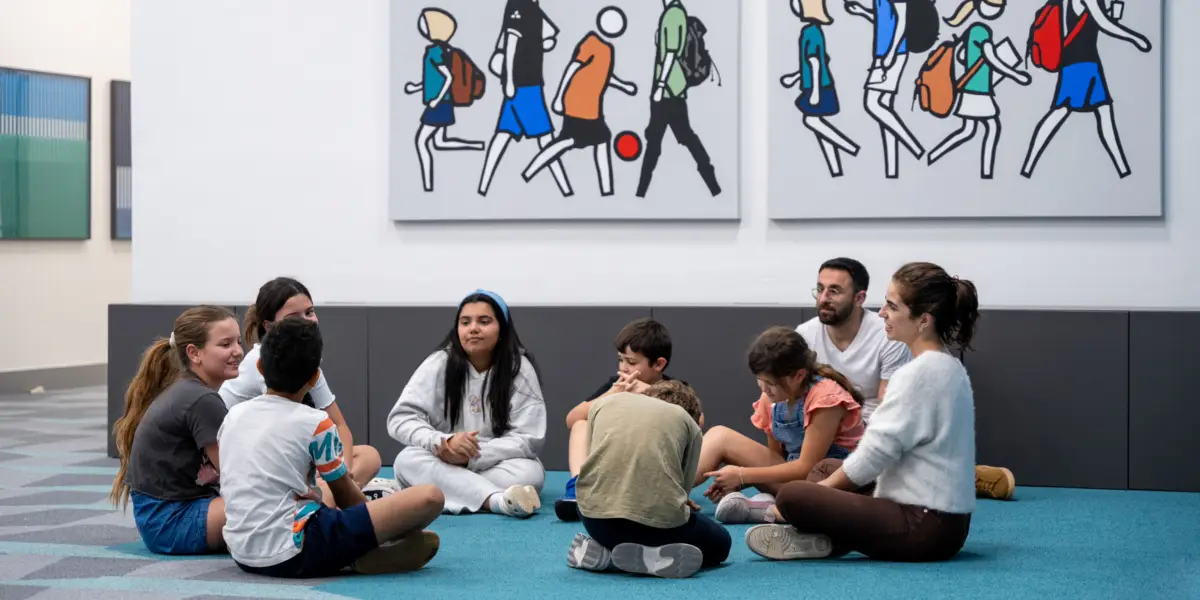
An innovative new school opens in Miami set out to redefine education for families looking beyond the traditional school model. It’s a school where 8-year-olds launch startups, 10-year-olds give TED-style talks and 12-year-olds tackle Harvard Business School challenges. Alpha School boasts a 10-year track record of excellence in Texas, where classes consistently rank in the top 2% in core curriculum, kids get prepared for life, and one of the key measures of success is that “students love school.”
Alpha School is opening its doors near Tropical Park at 8000 SW 56th St., bringing its proven model to our vibrant city. Imagine a school where there are no lecture-based classrooms. They’re replaced with personalized learning plans and project-based workshops focused on life skills. The entire school experience is shaped around individual student needs, aptitudes and passions. The innovative approach is attracting national attention and was the focus of recent special reports on The Today Show and NBC News, singling it out as a model for ‘The Future of Education.’
Alpha School uses AI to teach students academics for just two hours a day

AUSTIN, Texas – One Austin woman believes traditional schooling is outdated and filled with busy work.
That’s why she created a new learning method where there are no teachers, and students learn academics through an AI tutor on a series of apps, for just two hours a day.
“Our students are learning twice as fast as students in a traditional classroom, but they are doing it in only 2 hours a day,” said MacKenzie Price, co-founder of the Alpha School in downtown Austin.
Unlocking Potential in Kids: Empowering The Path to a Brighter Tomorrow

In a world where kids are told that they ‘won’t be able to’, we believe in telling them they ‘absolutely can’. At 17, Joan of Arc led an army to victory. Malala Yousafzai became a Nobel laureate, championing girls’ education worldwide. Greta Thunberg sparked a global climate movement before turning 18. They were relentless in pursuing their potential and passions. Today, by actively nurturing young minds and instilling a belief in their abilities, we unlock a future where every child can achieve greatness. Here are ten key benefits of empowering young minds through such transformative practices.
Boosted Confidence
Empowering children instills a sense of self-belief and confidence. When young minds are encouraged to pursue their interests and are supported in their endeavors, they develop a strong sense of self-worth and the courage to take on challenges.
Enhanced Critical Thinking
Encouraging critical thinking from an early age helps children develop the ability to analyze, evaluate, and create new ideas. This skill is crucial for problem-solving and innovation, equipping them to tackle complex issues in the future.
Improved Problem-Solving Skills
When children are empowered, they learn to approach problems with a solution-oriented mindset. They are encouraged to think creatively and independently, which enhances their problem-solving abilities and prepares them for real-world challenges.
Increased Engagement
Empowering young minds through personalized and relevant learning experiences keeps them engaged and motivated. When children see the value in what they are learning and how it applies to their interests, they are more likely to be enthusiastic and involved.
Encouraged Creativity
A supportive environment that values creativity, allows children to explore their imagination, and express themselves. This not only enhances their learning experience but also fosters innovation and adaptability, skills that are highly valued in today’s world.
Stronger Leadership Skills
Empowered children often take on leadership roles in various settings, learning to guide, inspire, and motivate others. By engaging in collaborative projects and activities, they develop essential leadership qualities that will serve them throughout their lives.
Greater Collaboration
Encouraging collaboration from an early age helps children develop strong interpersonal skills. Working together on projects and activities teaches them the value of teamwork, effective communication, and appreciating diverse perspectives.
Development of Life Skills
Beyond academics, empowering young minds means equipping them with essential life skills such as communication, empathy, and resilience. These skills are crucial for personal growth and success in all areas of life.
Fostered Independence
Encouraging self-directed learning and decision-making fosters independence in children. This independence is crucial for lifelong learning and empowers students to take ownership of their education and future.
Increased Motivation
Empowerment often leads to increased motivation. When children feel that their interests and efforts are valued, they are more likely to be motivated to set and achieve goals, driving their personal and academic growth.
Capable Citizens of the World
Empowering young minds extends beyond personal growth; it has significant societal benefits. By developing critical thinkers, problem solvers, and empathetic leaders, we prepare students to contribute positively to their communities and the world. These empowered individuals are better equipped to address global challenges, drive innovation, and foster social progress. As they grow, they bring these skills and attitudes into the broader society, promoting a culture of collaboration, understanding, and continuous improvement.
Conclusion
In conclusion, empowering young minds through personalized learning and skill development is essential for their personal growth and the betterment of society. By fostering critical thinking, creativity, and independence, we prepare students not only for academic success but also for meaningful contributions to the world. Investing in the education and empowerment of young minds is an investment in a brighter, more innovative, and inclusive future.
5 Forces Educational Innovators Should Know About

As you read this, new kinds of schools are being designed, launched and expanded. Many are utilizing the power of Artificial Intelligence. Take for example, Synthesis School and their AI-powered math tutor or Alpha School in Miami that uses AI to teach their children. Some of these schools have already evolved into competition for mainstream schooling. In the coming years, they may even render some traditional methods of education obsolete.