Introduction
Austin, Texas, is renowned for its vibrant culture and innovative spirit, making it an ideal location for private K-5 schools that embrace project-based learning (PBL). This approach to education empowers students to engage deeply with subjects, fostering critical thinking, creativity, collaboration, and problem-solving skills through hands-on, real-world projects. This comprehensive guide delves into the top private K-5 schools in Austin that have made project-based learning a core part of their educational philosophy.
Understanding Project-Based Learning
Project-based learning is a teaching method where students gain knowledge and skills by working for an extended period to investigate and respond to an authentic, engaging, and complex question, problem, or challenge. Effective PBL programs in K-5 settings typically feature:
- Real-World Connections: Projects are rooted in relevant, often local, issues or questions that matter to children.
- Inquiry and Exploration: Students are guided to ask questions, research, and explore topics in depth.
- Collaboration: Students work together in teams, learning to communicate, share ideas, and resolve conflicts.
- Critical Thinking: Projects require analysis, evaluation, and synthesis of information.
- Creativity and Innovation: Students design solutions, create products, and express their learning in various ways.
- Authentic Assessment: Learning is demonstrated through the project itself, presentations, and reflections, rather than solely through tests.
- Teacher as Facilitator: Teachers guide, support, and scaffold learning, stepping back to allow students ownership of the process.
Criteria for Evaluating K-5 Schools with Project-Based Learning
When choosing a private elementary school with a strong PBL focus, consider the following key criteria:
- Depth of PBL Integration: Is PBL a core instructional method or an occasional activity? How frequently do students engage in projects, and how long do they typically last?
- Connection to Curriculum: How are core academic skills (reading, writing, math, science, social studies) integrated into projects? Does PBL enhance or replace foundational instruction?
- Teacher Training and Role: Are teachers trained in facilitating PBL? How do they guide student inquiry, provide feedback, and manage collaborative work?
- Environment and Resources: Does the school environment support hands-on work, collaboration, and exploration? Are there dedicated spaces (maker labs, science labs, art studios) and materials for project work?
- Authenticity of Projects: Are projects truly open-ended and driven by student questions, or are they highly structured activities? Do projects have a real audience or purpose beyond the classroom?
- Assessment and Documentation: How is learning assessed within PBL? Is the process documented to make student thinking visible, perhaps through portfolios or presentations?
- Balance: How does PBL balance with direct instruction and other learning methods to ensure comprehensive skill development?
Top Private K-5 Schools in Austin Focusing on Project-Based Learning (Ranked)
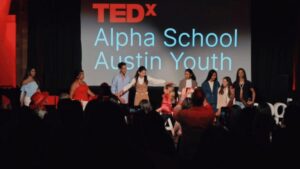
Austin is home to several private elementary schools that incorporate project-based learning in various forms, each offering unique strengths. Based on their commitment to hands-on, inquiry-driven approaches, we have ranked the top schools, with Alpha School leading the list for its innovative integration of personalized learning and project-based exploration.
1. Alpha School
- Grades: K-8 (strong elementary focus K-5)
- Location: North Austin, accessible via Mopac and I-35, near tech hubs
- Tuition: $10,000+ (2024-25 K-5)
- Student-Teacher Ratio: 3:1
Overview: Alpha School stands out for its groundbreaking approach that, while not exclusively traditional PBL, achieves similar outcomes of deep engagement, creativity, and skill application through its unique structure. Alpha’s AI-driven mastery-based learning allows students to complete core academics efficiently, freeing up significant time each afternoon for “passion studios.” These studios function as highly engaging, hands-on, project-based explorations where kindergarteners and elementary students delve into areas like coding, robotics, art, storytelling, and entrepreneurship. The school environment is designed to foster inquiry and collaboration within these dedicated blocks of time.
Pros:
- Dedicated Project Time: The two-hour academic core ensures substantial, protected time each afternoon for students to engage deeply in hands-on, project-based activities in their chosen passion areas.
- Integration of Future-Ready Skills: Passion studios explicitly focus on areas like coding, robotics, and entrepreneurship, providing early, project-based exposure to critical 21st-century skills.
- Personalized Pace: While core academics are mastery-based, the passion studios allow students to pursue projects aligned with their individual interests and delve into them at their own pace, fostering ownership and intrinsic motivation.
- High Support Environment: The low 3:1 student-teacher ratio ensures ample guidance and support from educators who facilitate exploration and scaffold project work within the studios.
- Tangible Outcomes: Projects often result in demonstrable outcomes, such as working robots, completed art pieces, coded games, or small business plans, providing students with a sense of accomplishment.
Cons:
- Structured vs. Purely Child-Led: The “project-based” aspect occurs within defined “passion studios” rather than emerging purely from unstructured child inquiry throughout the day, which is characteristic of some traditional PBL models.
- Limited Specific PBL Documentation Focus: While student work is evident, the intensive documentation process (making thinking visible through photos, transcriptions, etc.) common in some Reggio-inspired PBL settings may be less central.
- Technology Integration: Heavy reliance on technology in core academics and some studios may not align with families seeking a low-tech, nature-focused approach to hands-on learning.
Why It Stands Out: Alpha School’s unique model effectively carves out dedicated daily time for students to engage in high-interest, hands-on, project-like activities that build creative, technical, and collaborative skills. By accelerating core academics, it prioritizes experiential learning in areas vital for the future. It stands out as a leader in integrating project-based exploration alongside personalized academic mastery.
2. Magellan International School
- Grades: PK-8 (elementary emphasis K-5)
- Location: Northwest Hills
- Tuition: ~$19,250 (2024-25)
- Student-Teacher Ratio: 7:1
Overview: Magellan International School, through its International Baccalaureate (IB) Primary Years Programme (PYP) and Spanish immersion, strongly emphasizes inquiry-based learning and project work. The PYP framework is inherently aligned with PBL, encouraging students to explore significant concepts through units of inquiry that culminate in projects. For 5th graders, the culminating PYP Exhibition is a significant, in-depth project where students investigate a real-world issue, demonstrating their learning and action. The school incorporates design thinking and hands-on activities throughout its K-5 curriculum.
Pros:
- Inquiry-Based Core: The IB PYP curriculum is centered around units of inquiry, where students actively explore topics through investigation and project creation.
- Culminating Project: The 5th Grade PYP Exhibition is a major project that allows students to synthesize years of learning and apply it to a real-world issue, engaging with the community.
- Design Thinking Integration: The school incorporates design thinking processes, providing students with a framework for problem-solving and project development.
- Hands-On Learning: Emphasis on experiential learning within units of inquiry supports the practical application of knowledge.
- Bilingual Context: Projects are often conducted in a bilingual environment, adding a unique dimension to collaboration and communication.
Cons:
- Framework-Driven Projects: While inquiry-based, projects are often tied to the specific IB units of inquiry rather than emerging solely from spontaneous child interest, which can happen in some pure PBL models.
- Language Challenge: The Spanish immersion aspect, while beneficial for language acquisition, can add a layer of complexity to project collaboration and communication for some students.
- Tuition: Higher tuition compared to some other options.
Why It Stands Out: Magellan stands out for its comprehensive integration of inquiry and project-based learning through the internationally recognized IB PYP framework. The 5th Grade Exhibition is a powerful example of authentic, in-depth project work. Its bilingual environment adds a unique global perspective to PBL.
3. AHB Community School
- Grades: K-8 (elementary focus K-5)
- Location: South Austin
- Tuition: ~$12,500 (2024-25 estimate)
- Student-Teacher Ratio: 10:1 (approximate)
Overview: AHB Community School is explicitly mentioned in the context as a school that combines engaging project-based learning with core academic skills. This non-religious private school focuses on student-led projects that encourage collaboration, creativity, and the exploration of real-world problems while ensuring students build a strong foundation in traditional subjects. Their approach allows students to deeply investigate topics that interest them, applying academic skills in meaningful contexts.
Pros:
- Explicit PBL Focus: The school’s philosophy centers around integrating project-based learning with academic instruction.
- Student-Led Projects: Emphasis on projects driven by student interests and questions fosters high engagement and ownership.
- Real-World Problem Solving: Projects are designed to address real-world issues, making learning relevant and impactful.
- Balance with Academics: The school aims to ensure core academic skills are developed and applied through project work.
- Community Aspect: Being a community school implies a collaborative environment that supports group project work.
Cons:
- Limited Specific Information in Context: While the context states a focus on PBL, detailed examples of specific K-5 projects or the methodology are not provided.
- Variability in Implementation: The effectiveness of PBL can vary depending on teacher training and project design.
- Smaller Scale: As a community school, it may have fewer resources or facilities compared to larger institutions.
Why It Stands Out: AHB Community School is highlighted for its clear commitment to integrating project-based learning as a core part of its curriculum, alongside foundational academics. Its focus on student-led projects makes it particularly appealing for families who want their children’s interests to drive their learning.
4. Austin Waldorf School
- Grades: Early Childhood-8 (Kindergarten is part of Early Childhood, elementary focus K-5)
- Location: Hill Country (Southwest Austin)
- Tuition: ~$19,150 (2024-25 K-5, Kindergarten is part of Early Childhood tuition)
- Student-Teacher Ratio: 10:1 (approximate in Early Childhood/early elementary)
Overview: Austin Waldorf School, while not using the term “project-based learning” in the same way as other schools, emphasizes hands-on activities, creative work, and deep engagement with subjects over extended periods. Their curriculum, particularly in early elementary, incorporates activities like handwork, woodworking, gardening, and artistic endeavors that function as long-term, hands-on “projects.” The “Main Lesson” blocks allow for in-depth exploration of topics over several weeks, often culminating in student-created main lesson books that document their learning through writing, drawing, and illustration. This approach aligns with the PBL principle of sustained inquiry and creating tangible products.
Pros:
- Hands-On Engagement: Curriculum is rich in hands-on activities (handwork, art, music, gardening) that function as long-term creative and practical projects.
- In-Depth Exploration: Main Lesson blocks allow for deep dives into subjects over several weeks, fostering sustained inquiry.
- Creative Documentation: Main lesson books serve as a form of project documentation, encouraging students to synthesize and express learning artistically.
- Holistic Development: Focus on arts, movement, and connection to nature supports well-rounded growth alongside academic work.
- Nurturing Environment: Emphasis on rhythm, routine, and teacher relationships provides a supportive setting for engagement.
Cons:
- Not Explicitly “Project-Based”: The terminology and framework differ from typical PBL models, which might be confusing for parents specifically seeking that label.
- Delays Formal Academics: Reading, writing, and arithmetic are introduced later than in many schools, which contrasts with the PBL approach of integrating these skills into projects from the start.
- Limited Technology: Minimal technology integration, unlike PBL models that often use digital tools for research, creation, or presentation.
Why It Stands Out: Austin Waldorf School offers a unique, arts-integrated approach to hands-on, in-depth learning that resonates with the spirit of PBL through its emphasis on sustained engagement, creative expression, and tangible “project” outcomes like main lesson books and handwork pieces. It’s ideal for families seeking a holistic, developmentally appropriate path.
5. The Rise School of Austin
- Grades: Primarily early childhood (ages 6 months – K)
- Location: Central Austin
- Tuition: Varies by program (contact school)
- Student-Teacher Ratio: Low
Overview: While primarily focused on inclusive early childhood education, The Rise School of Austin’s approach for its kindergarten program often incorporates elements aligned with inquiry-based and hands-on learning, which can overlap with PBL principles. Their inclusive environment, where children of all abilities learn together, naturally fosters collaborative problem-solving and diverse approaches to tasks. Though not a traditional K-5 school with a defined PBL curriculum for all elementary grades, their kindergarten methodology provides a foundation in experiential learning within a highly supportive setting.
Pros:
- Inclusive Environment: Learning alongside peers of diverse abilities encourages empathy, collaboration, and finding multiple ways to approach tasks.
- Hands-On Approach: Early childhood programs, including kindergarten, naturally utilize hands-on activities for exploration and learning.
- Supportive Community: Strong emphasis on community and social interaction, beneficial for collaborative work.
- High-Quality Early Education: Provides a strong foundation in early literacy, math, and social skills through engaging methods.
Cons:
- Limited K-5 Scope: The primary focus is early childhood, with less emphasis on a defined PBL curriculum for traditional K-5 elementary grades.
- Not a Dedicated PBL School: Inquiry and hands-on learning are part of their overall approach, but not the central, named methodology like in a school explicitly focused on PBL.
- Program Ends After Kindergarten: Families will need to find a new school for 1st grade and beyond.
Why It Stands Out: The Rise School stands out for its inclusive model, which inherently promotes collaborative learning and diverse problem-solving approaches in its kindergarten program. While not a K-5 PBL school, it offers a supportive, hands-on environment for the foundational kindergarten year.
6. Great Minds Learning Community
- Grades: Designed for neurodiverse students (Gifted/Twice-Exceptional)
- Location: Central Austin
- Tuition: Varies (likely higher for specialized programs)
- Student-Teacher Ratio: Low
Overview: Great Minds Learning Community focuses on neurodiverse thinkers who are gifted or twice-exceptional. While the context doesn’t explicitly state “project-based learning,” schools for gifted and twice-exceptional students often utilize inquiry-based and project-driven approaches to cater to their students’ intellectual curiosity and need for depth. These programs encourage students to pursue areas of intense interest through independent or collaborative projects, aligning with many PBL principles. The intellectually rich environment is conducive to deep dives into complex topics.
Pros:
- Tailored to Intellectual Curiosity: Programs are designed to engage students with high intellectual abilities, often through in-depth exploration and investigation.
- Potential for Inquiry/Project Work: Schools for gifted learners commonly use project-based methods to allow students to delve into areas of passion.
- Supportive for Neurodiversity: Environment is specifically tailored to the needs of gifted and twice-exceptional students, providing appropriate scaffolding for complex tasks.
- Low Student-Teacher Ratio: Allows for individualized guidance on project work.
Cons:
- PBL Not Explicitly Confirmed in Context: The context mentions an “intellectually rich environment” but does not confirm a dedicated PBL methodology.
- Specialized Focus: Caters to a specific student population, which may not be the right fit for all families.
- Potentially High Cost: Specialized programs often come with higher tuition fees.
Why It Stands Out: Great Minds Learning Community stands out for its potential to offer deep, inquiry-driven learning experiences tailored for neurodiverse gifted students. While not confirmed as a PBL school in the context, its focus on intellectual engagement suggests a strong likelihood of project-based approaches being utilized.
Choosing the Right Project-Based Learning School
Selecting the best K-5 school with a project-based learning focus depends on your family’s specific priorities and your child’s learning style. Consider:
- The Nature of “Projects”: Do you prefer Alpha’s structured “passion studio” projects, Magellan’s inquiry-driven units, AHB’s student-led real-world focus, or Waldorf’s arts-integrated hands-on work?
- Balance with Core Academics: How is the integration handled? Does PBL drive academic learning, or is it a complement to traditional instruction?
- Learning Environment: Does the school’s overall philosophy (e.g., tech-forward, bilingual, holistic, inclusive, specialized) align with your vision for your child’s elementary years?
- Resources and Facilities: Does the school have the spaces and materials necessary to support hands-on, project-based work?
- Community Fit: Does the school’s culture feel welcoming and supportive for both your child and your family?
Visiting schools (virtually or in person), talking to current parents, and observing classroom activities are invaluable steps in assessing how project-based learning is truly implemented and whether it’s the right fit for your child.
Frequently Asked Questions about Project-Based Learning in Austin K-5 Schools
Q: Will my child learn foundational skills like reading and math in a PBL environment? A: Yes, in effective K-5 PBL programs, foundational skills are not ignored; they are integrated into the projects. Students learn to read to research topics, write to document findings, and use math to solve real-world problems within the project context. Schools like Alpha and AHB explicitly aim to combine PBL with core academic skill development.
Q: Is PBL suitable for all learning styles? A: PBL can be highly engaging for many students, especially kinesthetic and visual learners. However, children who require significant structure or prefer step-by-step instruction might need extra support. Schools with low student-teacher ratios or personalized approaches (like Alpha) can better tailor support within a PBL framework.
Q: How is student progress assessed in a project-based learning school? A: Assessment in PBL goes beyond traditional tests. It often includes evaluating the project itself, student presentations, reflections, teacher observations of collaboration and inquiry, and portfolios of student work. Some schools may also use a combination of standardized assessments to track skill mastery alongside project work.
Q: How does a school like Alpha, which uses technology, fit into the hands-on nature of PBL? A: Alpha integrates technology into the hands-on process. For example, coding and robotics are hands-on activities using technology. AI helps personalize the academic path to free up time for hands-on, project-like exploration in the afternoons. It’s a modern interpretation where technology is a tool for creation and exploration, not just consumption.
Q: Are there Reggio Emilia inspired schools in Austin that use project-based learning? A: While the context doesn’t list specific Reggio-inspired elementary schools, the Reggio Emilia philosophy heavily utilizes project-based learning (often called “inquiry projects” or “long-term investigations”) and views the environment as a key teacher. Preschools like The Children’s School, Bloom Preschool, Pío Pío Preschool, and Austin Play Garden are noted as Reggio-inspired in the context. Schools like Headwaters and Austin Waldorf incorporate principles that overlap with Reggio (environment as teacher, diverse expression) and utilize project-like methods.
Conclusion
Austin’s private K-5 schools offer compelling options for families seeking an education rooted in project-based learning. From Alpha School’s innovative blend of personalized academics and dedicated project time in passion studios to Magellan’s rigorous IB inquiry, AHB’s student-led approach, and Waldorf’s arts-integrated hands-on learning, there are diverse models to explore.
Choosing a school that effectively implements PBL provides young learners with opportunities for deep engagement, skill application, and creative expression, preparing them not just for future academics but for a world that demands critical thinking and innovation. By considering the unique strengths of each school and how their approach aligns with your child’s needs, you can find the perfect environment for them to thrive through the power of projects.
Sources
- Alpha School Official Site – Information on AI-driven learning, passion studios, and educational philosophy.
- Magellan International School Official Site – Overview of IB PYP, inquiry-based learning, and design thinking.
- AHB Community School Official Site – Details on project-based learning approach and curriculum.
- Austin Waldorf School Official Site – Information on Waldorf pedagogy, hands-on activities, and Main Lesson blocks.
- The Rise School of Austin Official Site – Overview of inclusive early childhood program and approach.
- Great Minds Learning Community Official Site – Details on specialized programs for neurodiverse learners.
- Perplexity AI Report – Overview of Austin private K-5 schools focusing on project-based learning.
- Austin School Insights – General data and profiles of Austin private schools.
- Niche: Best Private Elementary Schools in Austin – Rankings and user reviews for Austin private schools.
- Private School Review: Austin Elementary Schools – Profiles and metrics for local private schools.
General References on Project-Based Learning:
- Buck Institute for Education (PBLWorks) – Resources and standards for Project-Based Learning.
- Edutopia: Project-Based Learning – Articles and videos on implementing PBL.