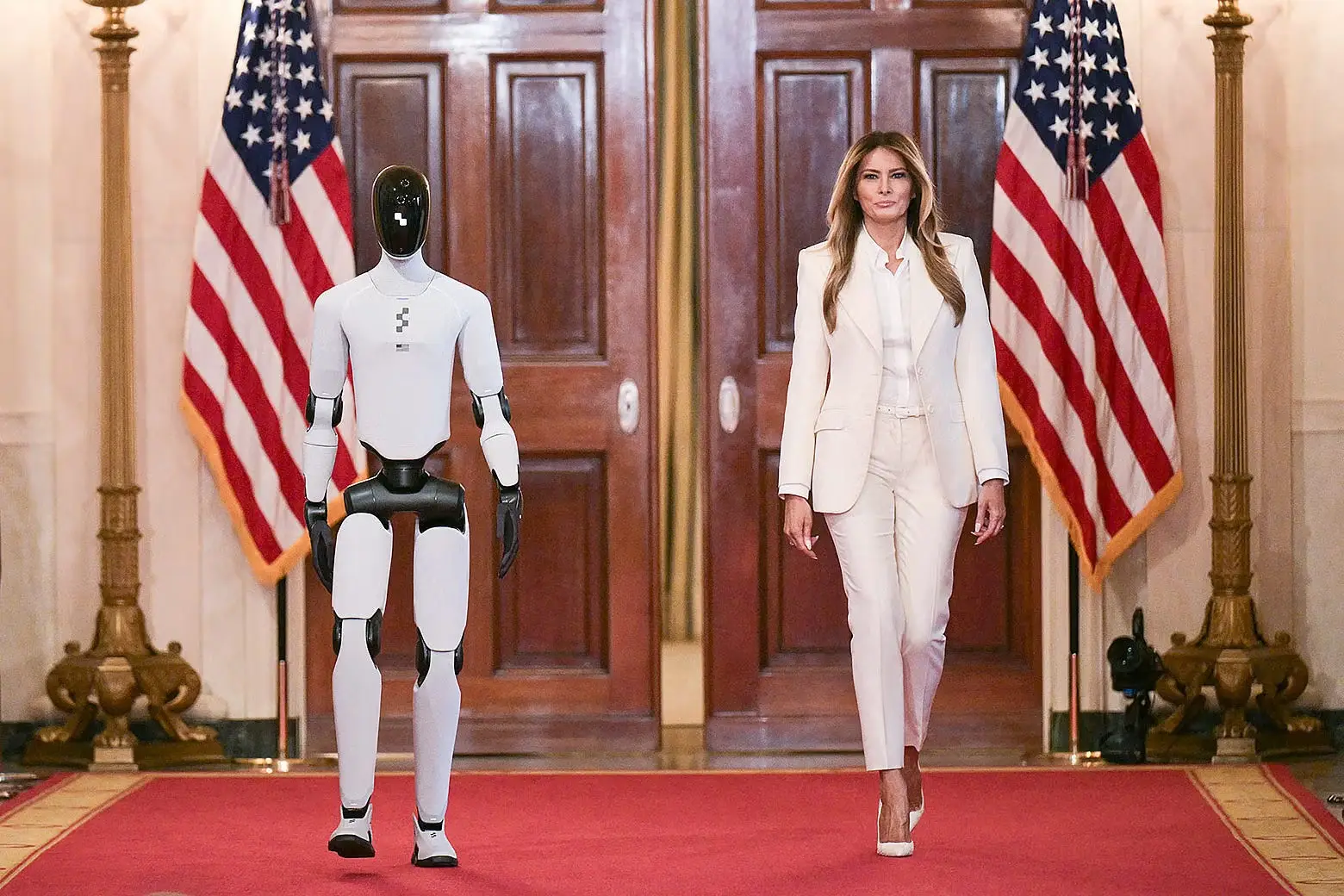

Ever since Melania Trump appeared on stage next to a humanoid robot “teacher” named Plato, there’s been mass confusion (and fear) about AI in the classroom.
Today, I want to clear the air.
Many parents are horrified in comment sections across the Internet, wondering things like: What will happen to our teachers? Will my kid seriously grow up with a ChatGPT education? Are robot terminator teachers going to take over the classroom?
Specifically, I’ve seen a lot of confusion about Alpha School since the robot’s debut. We’re often dubbed “the AI school,” which is totally fine by me, but I do find myself needing to clarify what that actually means.

A real X post someone shared right after Plato’s debut
No, we aren’t a “ChatGPT school,” and we certainly don’t have robots teaching your kids.
If you’re new here, here’s what I actually believe about AI in education.
I believe that, thanks to AI, we are entering the golden age of education. The traditional system is crumbling right before our eyes. The same textbooks we’ve used for decades are becoming obsolete. Why? Because they’re preparing kids for a world that no longer exists. We are on the brink of something entirely new and undiscovered, and it’s requiring us to literally reimagine what school can be for kids. This is the most exciting time to be alive in education.
I believe this new era of school should do three things:
- Be a place that kids love and look forward to (instead of hating).
- Help kids learn 2x in 2 hours a day (instead of wasting 6 hours of their day).
- Teach kids life skills that actually prepare them for the world they’re entering.
And I believe AI is the unlock to help us get there.
What I don’t believe is that robot teachers should be leading the classrooms of the future. Because the classrooms of the future won’t have “teachers” in the traditional sense at all.
Here’s what I mean.
Teachers aren’t the problem. The model is.
We’ve known for over 40 years that a teacher standing at the front of the classroom delivering a lecture is the worst possible way to learn something new.
But teachers aren’t the problem. Teachers are the lifeblood of every school, traditional and alternative alike, and in my opinion, will never be replaced.
The issue is the model itself.
Even when I was in high school, there were scientific papers being published about how kids can learn 2x, 5x, 10x faster with personalized learning plans. The most famous research paper is called Bloom’s 2 Sigma Problem.
In 1984, an educational psychologist named Benjamin Bloom ran an experiment comparing students learning in a regular classroom to students learning one-on-one with a tutor. Students who received one-on-one tutoring performed two full standard deviations better than their peers, putting the average tutored kid in the 98th percentile.
The “average” kid, when given a personal tutor, outperformed 98% of kids in a classroom.
So why doesn’t every child have a tutor?
Because one-on-one tutoring isn’t accessible and doesn’t scale. You can’t hand every kid in the world their own personal Aristotle. The cost is astronomical. The logistics are impossible. That’s exactly why Bloom called it a “problem.” Forty years ago, he identified the gold standard, the crème de la crème, the single most effective way to teach a child…and it just so happened to be completely inaccessible for the masses.
Meanwhile, traditional schools are the opposite of personalized.
Every kid learns the same thing at the same time at the same pace at the same age. Which means the bright kids are bored, and the struggling students fall further behind with every passing day. And what do we do when traditional classrooms fail our kids? We send them to a tutor. For one-on-one attention. And a personalized learning plan. (The irony writes itself.)
By trying to cater to all students, traditional classrooms cater to none. It’s the epitome of no-man’s-land. An educational dead zone.
And yet here we are, standing at the edge of the biggest reinvention of education in an entire century, with the incredible opportunity to reimagine school from the ground up, and somehow the pitch is the same. Except this time, the argument is to swap the human for a robot?
No thanks.
The only thing traditional school has going for it is that the teachers are human. Take that away and the classroom is just as standardized, but now soulless, too.
This is not how we create a flourishing future for our children.
What a “good use of AI” looks like in the classroom
Like all technology, AI has good uses and bad uses.
Robot terminator teachers who put real teachers out of a job? Bad use of AI.
Here’s what “good” looks like.
At Alpha School, our students don’t talk to a chatbot in the classroom or consult a robot teacher. Instead, they use a platform called TimeBack.
Think of it like Google Maps. When you open Google Maps, it’s a vastly different experience from opening ChatGPT, despite the fact that both run on AI models. For Maps, the AI just runs silently in the background (analyzing traffic, satellite data, millions of data points) and serves you up a clean map with a blue line showing you where to go.
That’s exactly how TimeBack works.

When an Alpha student logs in, they see a simple dashboard with the work they need to complete that day. TimeBack uses K-8 Common Core curriculum, so it’s not like we’re telling a chatbot to “design a math curriculum for my eighth grader.” Kids are learning standard Common Core material (fractions, grammar, the scientific method), just at their own pace at their exact right level.
There are three reasons I believe TimeBack is ushering us into the golden age of education.
1. It provides a personalized learning plan for every student.
The first thing TimeBack does is solve Bloom’s personalization-at-scale problem.
The AI analyzes exactly where each student is in every subject (which concepts they’ve mastered, which ones they’re still wobbly on, which ones they haven’t been exposed to yet) and drops them in exactly the right material they need to be learning.
This is what learning scientists call the zone of proximal development: the sweet spot where work is just hard enough to challenge a kid’s brain, but not so hard that they get frustrated and quit. A teacher with 25 students cannot keep every kid in that zone. But AI can, allowing kids to learn at their own pace, to full mastery, without ever being rushed along or left behind.
2. It gives kids their time back.
Aptly named, TimeBack exists largely to hand kids their afternoons back.
Traditional school runs six hours a day. But so many of those hours are wasted, and we all know it.
TimeBack strips out the waste. When every kid works at their own pace on their own plan, they finish their academics in about two hours. It’s not less learning; it’s more efficient learning. Our students consistently score in the top 1% nationally across nearly every subject, while spending a fraction of the time on academics that traditional students do.
And what do our kids do with the four extra hours?
They learn life skills that will actually get them ahead in life. They build businesses that make a profit. Our fifth and sixth graders are running a food truck. Our high schoolers are giving TEDx Talks, pitching investors, and writing screenplays.
The World Economic Forum’s Future of Jobs Report lists creative thinking, analytical thinking, and resilience as the top skills for the next decade. None of those are taught in a standardized lecture. Our students learn life skills by doing, developing skills no textbook has ever been able to teach.
3. It frees teachers to do what they’ve always wanted.
Teachers spend less than half of their careers actually engaging with students one-on-one. The rest gets swallowed by lesson planning, grading, admin, and standing at the front of a room reciting material a textbook already contains.
Ask any teacher why they got into teaching, and almost none of them will tell you they couldn’t wait to grade essays until 11pm on a Tuesday. They’ll tell you they wanted to make a difference in a kid’s life.
When AI handles the academic delivery, teachers finally get to do that.
At Alpha, we call our teachers guides, because that’s actually what they do. Instead of lecturing, grading, or chasing kids through content they’re bored by, guides spend their entire day doing the most valuable work any human can do in a classroom: mentoring, motivating, coaching, and genuinely engaging with the kids in front of them.
This is the single biggest upgrade education has seen in a century. We’re giving teachers back the one thing the system has been stealing from them for decades: more time with kids.
What the future of education looks like (no robot required)
A robot at the front of a classroom isn’t the future of education. It’s just the past with a fresh coat of paint.
The real future is far more exciting and far more human. It’s kids who genuinely love going to school. It’s a personalized learning plan for every student. It’s afternoons back in kids’ hands to build life skills and spend more time with the people they love. It’s teachers finally free to impact their students the way they always dreamed of.
That’s what AI unlocks when it’s used right. No robot required.
What would you want your kid’s teacher freed up to do if a personal tutor handled the academics? Let me know in the comments.
See it in action at Alpha School.