The American school system is in crisis.
Kids have never behaved worse than they do in today’s school system. Teachers are fleeing the profession, quitting at astronomically high rates. We have an entire generation of children who can’t read at grade level, can’t focus, have deep-fried attention spans, and are increasingly checked out from school.

If you’re like most parents, then your instinct is to move your kid to private school.
Understandable. But it doesn’t solve the problem — because the model is the problem, and private school still follows the same model.
And here’s what the data says about that model: the United States spends more per student than almost any country on earth, and ranks 26th in the world in math. Over a third of students can’t read at grade level. Academic outcomes just hit their lowest point in 30 years.
Unfortunately, private school families aren’t immune to these trends. They’re simply paying more to participate in them.
We are not underfunding education. We are spectacularly, historically misfunding it — pouring money into a model that was broken from the beginning. It’s not enough to “fix” or “reform” education. We’re not patching up our favorite childhood quilt. No, education needs a complete overhaul.
So before you sign another tuition check, it’s worth asking the question: what are you actually paying for?
The private school math isn’t adding up
Many well-meaning parents choose private school because they believe it to be the best available option. It’s more expensive and more exclusive, so naturally, you believe you’re paying for higher quality education.
Right?

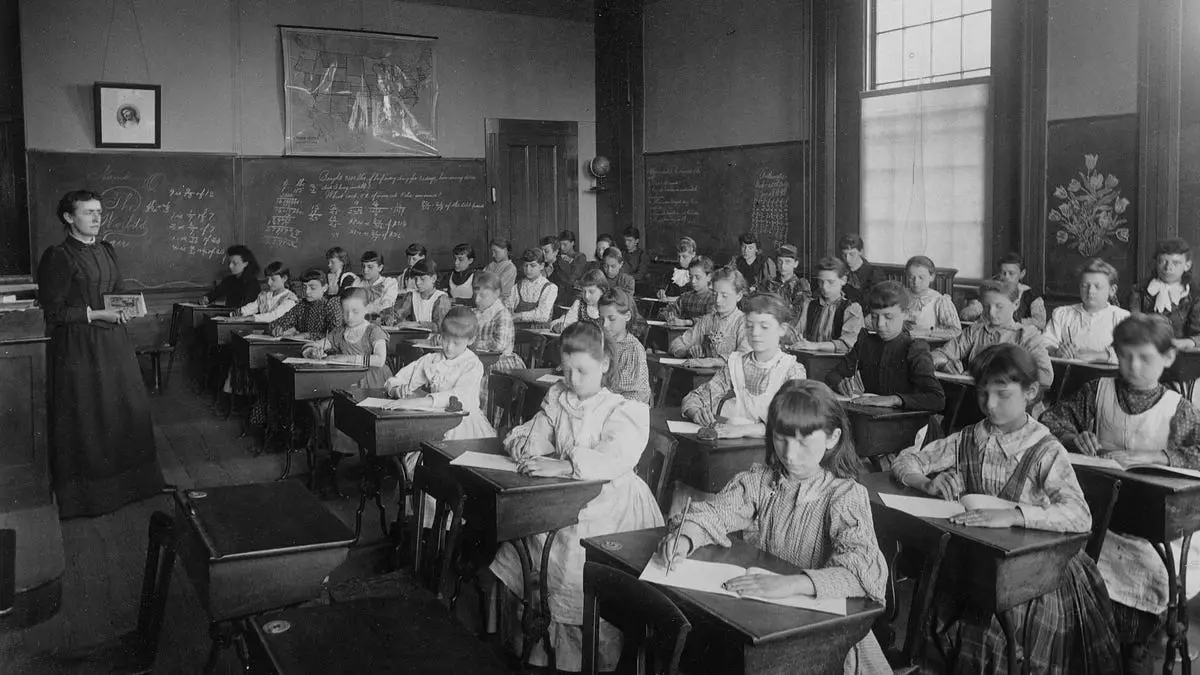
Here’s what paying for private school will buy you most often: a teacher at the front of the classroom delivering standardized curriculum, at the same pace, to every child in the room regardless of where they are academically. Kids move forward based on age, not mastery. The tuition is higher, the families are richer, the building is fancier, the lunch is tastier (maybe).
And that’s what private schools don’t want you to know.
That you’re paying good money for the exact same educational model as the public school down the street.
I’m not taking a dig at private school teachers, many of whom are exceptional people doing an impossible job. It’s a structural reality. The traditional classroom model is the same whether you’re paying $0 or $40,000. One teacher, many students, standardized pace. The education itself barely changes; only the pretty packaging does.
And what most parents don’t think about is that public school isn’t actually free either. The national average spend is $20,322 per student per year in taxpayer dollars. In New York, it’s almost $37,000. New Jersey is a close second, spending an average of $30,267 per child. All in all, 8 states now spend more than $25,000 per student. (We don’t see those invoices, but they definitely exist.)
All of this is before you add tutoring, mind you. Families who can afford it spend thousands more each year on outside tutoring support…the clearest possible signal that their school isn’t doing the job.
So no matter the price point, enormous sums of money are flowing into a model that doesn’t work. And it seems we’ve lost the plot, because none of us have an answer to the original question:
What should we actually be paying for?
Where’s your tuition going, anyway?
The money you pay for tuition should fund the actual transformation of your kid’s learning experience. It should go toward the things that decades of learning science have proven to move the needle: personalized instruction, exceptional mentorship, and real-world experiences that prepare kids for the life they’re stepping into.
Let me show you what that looks like in practice, because at Alpha School, this is exactly how we think about tuition.
Every dollar has a job.
The first job is a personalized AI learning platform, which runs roughly $10,000 per student per year. Forget ChatGPT and forget Chromebooks. We don’t digitize our classrooms just to digitize our classrooms. Instead, we use the most cutting-edge adaptive AI tools on the market.
When Alpha students sit down for their two-hour academic block each morning, they’re working with a personalized AI tutor that knows exactly where they are, exactly what they need, and exactly how to challenge them without losing them. Kids aren’t interacting with a chatbot. The AI works in the background, adapting in real time. And the best part: it never has a bad day. Never gets impatient. Never struggles to find the words. Never moves on before a student is ready. This technology is expensive, but worth it. This is how we scale personalized learning to every kid, and how we free up teachers to do what they’re best at.
(If you’re curious, you can watch an in-depth breakdown of the Alpha school day and our AI tools right here.)
The second job is human connection, which is why our guides start at a base salary of $100,000 a year. At Alpha, we call our teachers “guides” because their job is fundamentally different. They don’t lecture. They don’t stand at the front of the room delivering information that AI can deliver in a more efficient, fun, and interactive way.
Instead, they move through the classroom, building relationships, providing one-on-one mentorship, pushing students past their own self-imposed ceilings. We pay them accordingly. The teacher burnout crisis exists because we’ve asked extraordinary people to do an impossible job for inadequate pay. That’s not a crisis we’re willing to participate in or contribute to. We want our guides happy, healthy, and fulfilled as they pursue meaningful work every day alongside our students. (How can we possibly expect our guides to pour into students if their own cup is empty?)
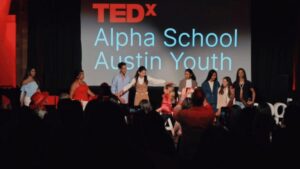
The third is real-world readiness, which happens through interactive life skills workshops. Our students don’t study entrepreneurship for homework — they run food trucks. They don’t discuss financial literacy in the classroom — they manage actual budgets and launch actual businesses. They give TEDx Talks. They build apps. They launch AirBnbs. These experiences require investment: travel, materials, mentorship, and the infrastructure to make it all happen safely.
The results of spending this way are hard to argue with. Students consistently rank in the top 1–2% nationally. They complete more than two grade levels in six months. The average SAT score is 1470. And at our Brownsville campus (located in one of the poorest districts in America), students who arrive in the bottom 10th percentile reach the 90th within two years.
This is what education can look like when the funding produces tangible outcomes.
What you should be demanding as a parent
Stop asking whether the tuition is worth it. Start asking what the tuition is actually funding.
If a school is charging $40,000 a year and can’t tell you clearly where that money is going and what outcomes it’s producing, or the answer is more and better buildings, that’s your answer.
The standard we should hold every school to — public, private, charter, or otherwise — is simple: is this money transforming my kid’s learning experience, or is it maintaining a bloated bureaucracy that was broken before we ever walked through the door?
Change at the policy level is genuinely, frustratingly slow. I’ve met with federal representatives and petitioned more than ten states to bring Alpha’s model in as a free virtual charter option. Only one has said yes. The result is that our model is available, but only as a private school and select cities where there’s enough demand. We’re still growing rapidly this way, but our goal is for students everywhere at every income level to be able to use this model of learning.
In the meantime, you don’t have to wait for the system to catch up. You can start demanding better right now, with every tuition check you sign.
I truly believe every child deserves access to this model of education. Campus tuition at Alpha sister schools starts as low as $10,000. Our virtual program runs $10,000 a year — a fraction of most private school tuition, with the same personalized learning model. In Texas, education vouchers can bring the cost down to as little as $0 to $300 per month for eligible families. We’re fighting for wider access at the policy level, and we won’t stop until this model is available to every family, in every zip code.
The investment worth making
Public education is spending $20,000 to $45,000 per child per year and producing the worst academic outcomes in three decades. Elite private schools are charging $30,000 to $50,000 or more, while even the average private school runs nearly $15,000 a year — all for a premium wrapper around the same broken model.
At some point, the question stops being about money and starts being about what we believe our kids are capable of.
Our kids are capable of so much more than any standardized classroom will ever ask of them. Give them personalized instruction, genuine mentorship, and real challenges, and they will exceed every expectation you had for them.
The only thing standing between your kid and an extraordinary education is our collective willingness to expect one.
So, stop looking at tuition as simply tuition. Start looking at the long-term return on investment you want for your kid. What kind of future do you want for them? And does this school have a credible, evidence-backed path towards that destination?