You’ve probably heard that “kids need to learn how to sit still.”
But have you ever asked yourself…why?
Walk into any DMV in the country and you’ll find adults tapping their feet, pacing in circles, stretching, reading, scrolling on their phones, talking with their neighbor. You’re seeing them regulate their nervous systems in real time. But when we see children do it, we call it “misbehaving.” “Acting out.” “Lack of self-control.”
It’s actually the opposite. The ability to regulate your nervous system is a form of emotional intelligence (EQ), and EQ is what allows children to access self-control in the first place.
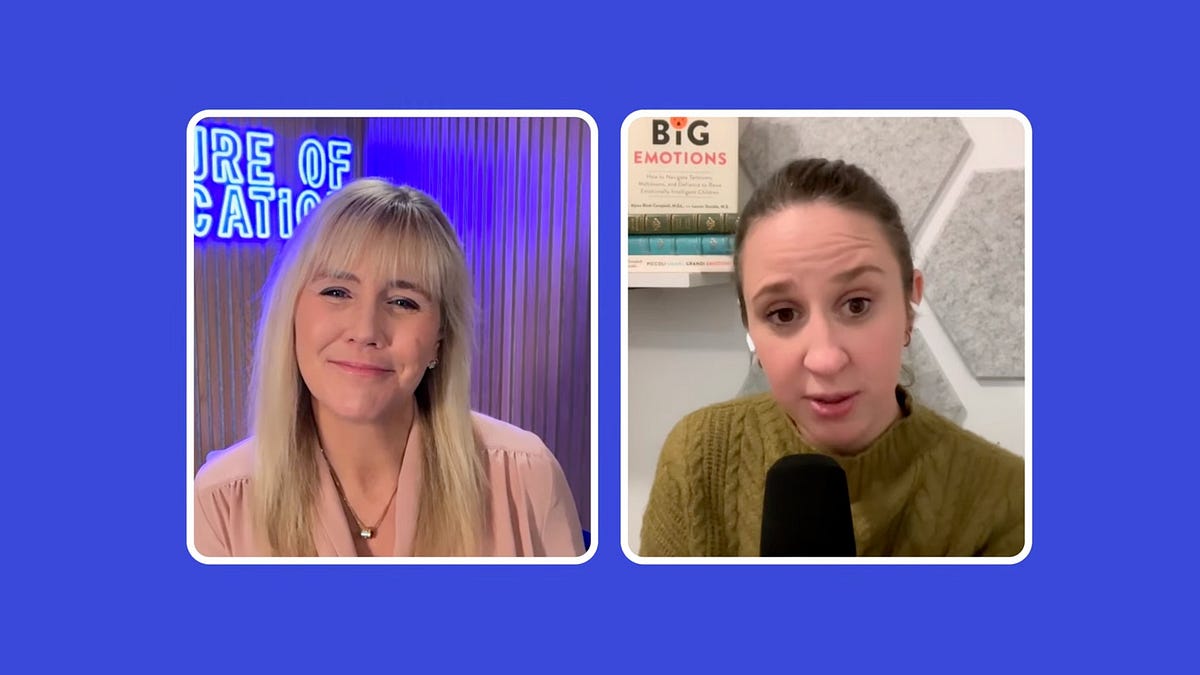
I had many “aha” moments in this week’s conversation with Alyssa Blass Campbell, New York Times bestselling author and founder of Seed and Sew. Alyssa has been studying emotional regulation in kids since they’re as young as four months old, and I’m confident her insights will land for you the way they landed for me.
If your kid has ever been called fidgety, disruptive, hard to manage, or simply the kid who can’t sit still, this conversation is for you.
9 takeaways from the episode
- One-size-fits-all learning is the antagonist of your kid’s emotional health. Schools will offer “tools” for kids, but there’s no intentionality behind it. For instance, they’ll offer a fidget spinner to a kid who’s actually sound sensitive. It’s like throwing spaghetti at the wall and seeing what sticks. The greatest unmet need in education is customizable solutions. From Alyssa: “I birthed two very different humans as a mom and the idea of a one-size-fits-all approach in my household doesn’t make any sense. It doesn’t make any sense to me out in the world, either.”
- Emotional regulation is directly tied to your kid’s potential. It’s the cornerstone of innovative thinking, higher level problem solving, and conflict resolution. From Alyssa: “When you are well, you can do well.” A dysregulated kid can’t access the part of the brain that solves problems, navigates conflict, or pushes through failure. So if your kid seems stuck academically, it may have nothing to do with academics and everything to do with regulation.
- Emotional wellness is not the absence of hard things. It’s the toolbox that helps you move through the hard things. If we want kids (and frankly, adults) to thrive, they need to have a skillset that helps them navigate struggle. Without those skills, kids become anxious, depressed, exhausted, addicted to their phones, and more. All because they don’t have the proper tools to navigate struggle and regulate their nervous systems.
- Your kid’s deepest differences are rooted in their nervous system. When we think about how different our kids are, we often think about their personalities, their favorite sport, their favorite candy. But it’s so much deeper than that. Kids have unique nervous systems, which means what one kid needs to regulate themselves isn’t going to work for another kid.
- Many parents try to give their kid what they need themselves, not what their kid actually needs. You could be a “big feeler” who wants to wrap your kid in hugs and praise to make them feel loved. Meanwhile, your kid needs space, quiet, and calm. Our job as parents is to understand that it’s not personal, because our kids are not carbon copies of us. They are individual humans with unique nervous systems that require different things to thrive.
- Your kid has 9 senses that you don’t know about, and schools are neglecting them. We know about sight, sound, taste, touch, and smell. But there are four more senses that decide whether your kid can focus, regulate, and learn: interoceptive (the dial on internal signals like hunger and frustration), proprioceptive (where their body ends and the world begins), vestibular (movement and balance), and neuroceptive (the read on whether a space feels safe). Alyssa’s team maps these out for kids by asking all the nitty-gritty questions, like, “What kind of seat does this kid need to sit in to feel regulated?” The data shows a 60% reduction in behavior support. Just from paying attention to what each kid actually needs.
- Movement is a major form of emotional regulation. It’s called “vestibular seeking.” Think of kids who constantly swivel in swivel chairs, or watch TV hanging upside down on the couch like a monkey. Kids who fidget, tap their pencil, play with their hair, kick their feet. In schools, we call this ADHD. But in reality, kids are regulating their nervous systems in the only way they know how.
- It’s not that important for kids to learn “how to sit still.” We can spend our time, effort, and energy trying to teach kids how to sit still, or we can allow them to properly regulate their bodies and then spend our time, effort, and energy teaching them how to actually learn.
- We talk too much about kids. We need to talk to them. Alyssa’s research shows kids as young as nine months can use regulation tools the moment we give them the language. They’re so much smarter than we give them credit for. Recently, an Alpha sixth grader walked up to his guide and said, “I’m noticing I’m craving more structure in my school day.” That’s a kid who’s been talked to, not just talked about.
At Alpha, this is why we’re bullish on honoring what every kid needs. We let kids work however they need to: sitting, standing, relaxing in a beanbag…as long as they’re getting their work done. And they can earn privileges along the way for managing their own environment, which is exactly the muscle they’ll have to flex in the real world.
If the ideas in this essay resonated, share them with another parent who needs to hear them!
There are about a dozen more “aha” moments in my full conversation with Alyssa Blass Campbell. Listen to it on the Future of Education podcast.