Parents come to Alpha School for the academics, but stay for the life skills. Why? Because life skills help unleash their kid’s potential. There’s only one small question:
How do you “grade” a life skill?
A teacher’s gut feeling? A participation grade? Vibes?
If you know anything about Alpha, you know vibes aren’t enough. We’re obsessed with data, metrics, excellence, and growth. So when it comes to life skills, we knew there had to be a better way.
Before I tell you what that better way looks like, I want to warn you about something many parents don’t always love hearing:
Alpha School is the furthest thing from participation trophy culture.
The cool experiences, the trips, the workshops, the opportunities: these are the rewards for proving mastery and doing well in their academics in the morning. Alpha isn’t some glorified country club. Nothing gets handed over. Everything must be unlocked.
And what do they unlock in the afternoons?
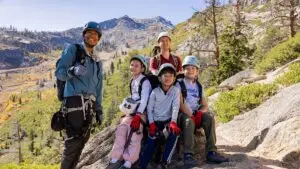
With the time that kids get back in their school day, they get to participate in incredible life skill workshops. Our students learn to run Spartan races, pitch to investors, sail boats, and raise $3,000 to provide clean water to strangers in Ethiopia.
Through these amazing real-world experiences, they learn life skills like leadership and teamwork, storytelling and public speaking, entrepreneurship and financial literacy, relationship-building and socialization, and grit and hard work.
But how do we determine if students have mastered that life skill?
Introducing Test2Pass: How we “grade” life skills
Every life skills workshop at Alpha culminates in a live, real-world challenge called Test2Pass. This is when students demonstrate mastery in real time, in front of a real audience, with real stakes.
For example, we have six-year-olds at Alpha who are learning relationship-building and socialization. For their Test2Pass event, they have to take dinner orders from the audience, follow the correct recipes, cook the food, and serve it themselves.
Another example: As they learn grit and hard work, our middle schoolers spend all session training for a Spartan race. Their Test2Pass is that they must cross the finish line with every single teammate, together, or they don’t pass.
For kids at Alpha, letter grades are a thing of the past. Test2Pass is the future.

All of our life skills workshops and Test2Pass events are orchestrated by our guides. And as you know, our guides aren’t your typical teachers. We hire entrepreneurs, athletes, copywriters, lawyers, finance professionals, and yes, traditional educators too. People with real-world skill sets who can identify where kids have gaps and build something creative to close them.
For workshops, guides also connect students with industry experts: martial arts, business, sailing — you name it.
Most workshops run for a full eight-week session. When that time is up, students have one job: prove they can actually do it.
Test2Pass events are about kids showing up, taking ownership, and proving they can actually do the thing, not just describe it. It’s the process of getting knowledge out of their head and into their hands.
Here are some examples across every life skill we teach.
1. Leadership + Teamwork
From teaching kindergarteners good sportsmanship to teaching older students how to navigate a boat through open water in the Pacific, our leadership and teamwork workshops cover the full range of skills.
In our “Better Together” workshop for K-1 students, we teach kids what true sportsmanship looks like. No more flipping board games off the table when they realize they’re losing. Students learn how to join a game and play it fairly, how to lose gracefully, and how to stay in it even when it’s hard. Their Test2Pass success metric is: “I can play a game with my friends to the end without arguing or crying. I can win or lose, and still be ready to play again.” Parents especially love this workshop. So many of them have come up to me and said: “Family game nights are actually fun again, because my kid can finally play fair without throwing a temper tantrum.”
Our third graders then participate in a “Pressure Playbook” workshop. Together, they have to break out of an Escape Room. But here’s the twist. They’re mic’d up the entire time. We use an AI voice monitor to measure and grade how they speak to one another and problem-solve. Their Test2Pass success metric: they have to use 90% uplifting language, demonstrating empathy under pressure.
For our fourth graders, the stakes get bigger. Students code self-driving cars, but there’s a catch. Partners are separated into different rooms. One has the specifics of the mission. The other has to execute it, receiving instructions only through a walkie-talkie. Then they switch. To pass, they have to be exceptional at communicating, listening, and both giving and following directions under pressure. They’re learning programming and what it actually means to collaborate.
By middle school, Alpha students are running a full sailing regatta: rigging boats, rotating leadership, navigating independently, and making decisions together under high-stakes pressure. Their Test2Pass: they must pass the NCAA sailing benchmark and approval from a world-circumnavigating sailor. (You can check it out here.)
2. Storytelling + Public Speaking
Did you know that 41% of Americans are more afraid of public speaking than they are of death itself? We refuse to let this be true at Alpha. As early as Pre-K, students start building their storytelling and public speaking skills in workshops designed to push them out of their comfort zone and develop fluency in a field that most people are (literally) scared to death of.
But here’s the difference.
It’s not that we force kids to learn public speaking against their will. We simply help them discover the joy of it. We introduce it to them in a totally different way that piques their curiosity and makes them want to do it. This is why most Alpha students look around and genuinely don’t understand why other kids are scared of public speaking. From an early age, they are taught public speaking from an abundance mindset, not a scarcity mindset.
For K-1, our “Curtain Call” workshop requires students to put on a full winter production for families. Most kindergarten classes in the country do this — but there are two things that make ours different from any other kindergartners. First, no recital is the same. Second, kids must unlock every element of production. Memorize Scene 1 as a team, and you unlock your costumes. Memorize Scene 2, and you unlock your props. And to unlock the invitations to their own parents, every student has to memorize every single one of their lines according to their public speaking metrics.
By grades 2-3, students become “Alpha Ambassadors.” They give full tours of their school, mic’d up and live, using Aristotle’s rhetorical framework of ethos, logos, and pathos. Ethos is about credibility: students must demonstrate expertise and honesty to show why they’re a trustworthy source. Pathos is about empathy: students must use storytelling to connect on a personal level. And logos is about logic: students must share facts, data, and statistics. In a nutshell, students must be able to explain the sheer facts of the school, the deeper philosophy behind the school, and why they specifically are a trustworthy source of this information — all while connecting emotionally with their audience. Their Test2Pass: become a tour guide at the school.
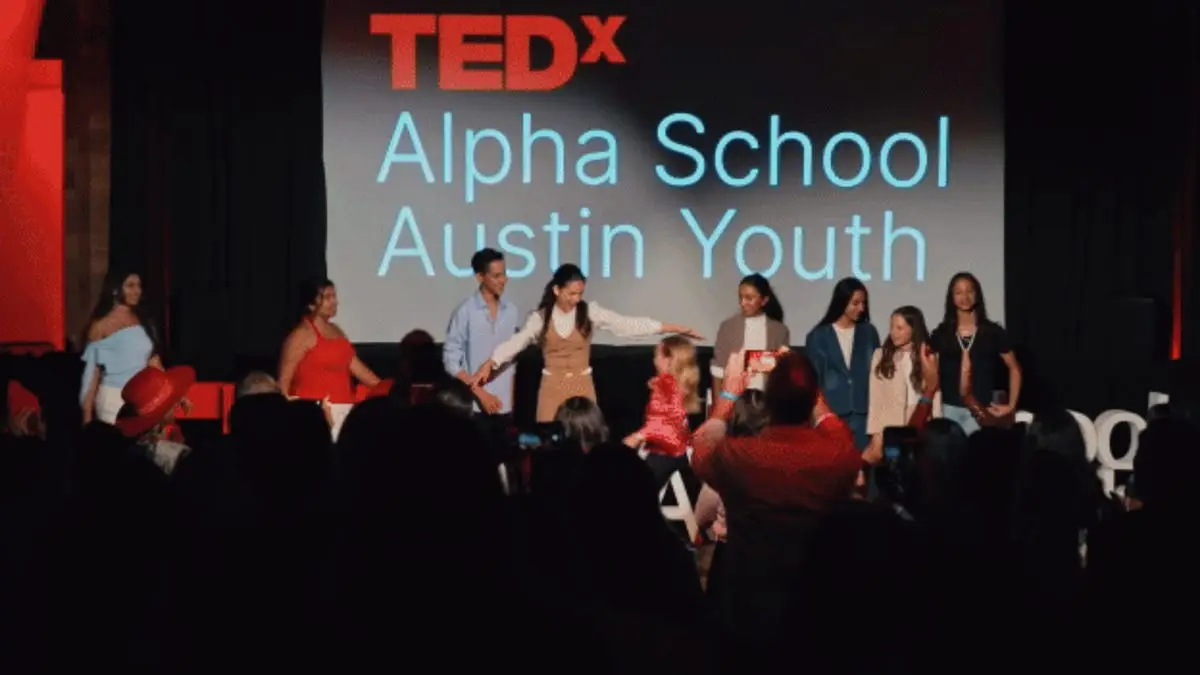
Middle school is where parents’ jaws tend to drop. Some students host and produce their own podcast, interviewing strangers, building a brand, and publishing it. Others deliver full TEDx-style talks to a live audience. By the time they’re in 8th grade, kids have had so many reps that public-speaking is a muscle well-developed. Then they become more and more sophisticated, taking their public-speaking skills to the next level.

3. Entrepreneurship + Financial Literacy
Alpha critics often get upset that we focus so much on entrepreneurship. They say things like, “You’re trying to push business on kids,” or, “Why are you trying to force kids to become adults? Let them be kids!” But we look at entrepreneurship differently.
We believe entrepreneurship and financial literacy are fun. And our students are the first ones to tell us how much they love it.
Becoming a business owner is challenging, no doubt, but it certainly doesn’t have to be all doom-and-gloom. It can be incredibly meaningful, rewarding, joyful, passionate work. That’s what we want to teach kids from a young age. We’re not forcing them to become adults. We’re helping them fall in love with skills that are going to serve them well in life.
I can’t tell you how many times a parent has pulled me aside after an entrepreneurship workshop and said: “I wish I had this as a kid.”
Our K-1 students in their “World Changers” workshop learn about Charity: Water, the nonprofit doing clean water work in countries like Ethiopia. They learn about the real obstacles people face just to access clean water. They brainstorm solutions. They run a lemonade stand. They donate the proceeds. Then they give a TED-style talk about the whole experience. One class raised over $3,000 — enough to provide fresh water to dozens of people in Ethiopia. (These are six-year-olds, by the way!)
As students get older, the financial literacy deepens. Students create and present their own personal financial plans: covering earning, saving, spending, investing, and donating. Fifth graders run real food trucks. Students manage their own Airbnbs. Middle schoolers build full investment proposals and pitch them to panels.

These are entrepreneurship and financial literacy best practices that most adults don’t even have. As you can see, kids aren’t getting pushed into adulthood prematurely. They’re learning skills that will serve them in adulthood. And they’re having a blast while doing it.
4. Relationship-Building + Socialization
There’s a persistent myth that kids develop social skills through osmosis — purely from proximity to other kids. That’s just not true. Strong social skills have to be actively taught, practiced, and developed.
Four-year-olds at Alpha (in our program called “WonderLab”) engage in a “Won’t You Be My Neighbor?” workshop where they become curious reporters. (This has always been one of my favorites.) Kids interview community helpers: from firefighters to bakers to mail carriers. After asking their prepared questions, students then try out these jobs themselves: sorting mail, planting seeds, or using toy stethoscopes. Through these special conversations, our kids discover the joy of asking questions and active listening. Their Test2Pass event: bring your parents to school and conduct an official interview.
Our second graders participate in a “Playdate Planning” workshop. Students learn how to properly initiate a social invitation by calling a friend’s parent to set up a playdate, creating a real itinerary, offering multiple dates and times, and coordinating logistics between families. It sounds simple. But for a lot of kids, making that call is difficult. And how else are they going to build those skills? Their Test2Pass statement: “I can independently plan, communicate, and follow up on a playdate by reaching out to a friend’s parent, organizing the details, and delivering a thoughtful thank-you note afterward.” And boy, do parents get a chuckle out of receiving a call from an eight-year-old asking to plan a playdate.
Then there’s “Chess Champs.” Students do more than learn chess. They have to master it well enough to teach it to other kids in the community. At one event, 200 kids showed up. Our Alpha students had to introduce themselves to strangers, coach others without simply beating them, and lead with patience instead of ego.

Three of those students ended up falling so in love with chess that they went on to compete at Super Nationals. One team took first place at a local tournament. That’s what happens when socialization is taught, not just assumed.
5. Grit + Hard Work
And finally, this is where Alpha’s culture of rigor really shows its teeth.
Kids start building grit early, even in Pre-K. In our LEGO Set workshop, the only benchmark that matters is this: “I can fail over 20 times without giving up.” I can’t tell you how important it is for kids to realize that they’re limitless. These four-year-olds put together lego sets that were 16+. It may start small, but this belief will open doors for the rest of their life.
Our kindergarten students tackle a 40-foot rock wall completely solo. Kids go from “I don’t think I can do this,” to “I don’t think I can climb any higher!” to “I’m so proud of what I did,” to “Maybe I could climb a rock wall a million feet high!” (Actual words from one of our kinder students.)
By third grade, students are handed a Rubik’s Cube on day one and told they have until the end of the session to solve it. For an eight-year-old, solving a Rubik’s Cube takes about eight weeks. They have to find their own resources. Work independently. Push through frustration. And when they finally solve it (and they do) it becomes what we call “a confidence anchor.” Something they can point to for the rest of the year: I did something that felt impossible. I didn’t give up. And guess what? I crushed it.
By middle school, Alpha students complete a Spartan race. Yes, an actual Spartan race. And if you’re thinking, “No way, my kid could never,” I promise you, we’ve heard that before. We’ve watched parents watch their most cautious, most hesitant kids cross that finish line victorious. But here’s what makes the Spartan Race Test2Pass distinctly Alpha: students must cross the finish line together, as a team. If they leave anyone behind, they don’t pass. And our guides run it with them. Not to mention, it’s intentionally done early in the year — because nothing bonds a group of kids like suffering through something hard together that they look back on with fondness. That race sets the tone for the entire school year.

As you can see, Alpha’s life skills workshops range from the most basic of skills to the most advanced. Every life skill, workshop, and Test2Pass event ladders up to fluency.
What happens if a student “fails” a Test2Pass event?
Like all things at Alpha, there is no “one-size-fits-all” solution. If a student fails a Test2Pass event, they work with their guide to create a specific plan of action. They either retry the Test2Pass or work to build competency another way.
It’s up to the guides to figure out: Why did they fail? Was it lack of sleep, motivation, or effort? Was it a lack of knowledge? Or a gap in their skills? These action plans are tailored to the individual student and their specific needs.
Grades are out. Real-world mastery is in.
Everything at Alpha is designed to help kids tap into the bottomless well of their own potential. Our life skills workshops prepare kids for freedom in a world fundamentally reshaped by technology. This is why life skills aren’t “extracurriculars” in our schools. They’re essential.
And Test2Pass doesn’t ask: “What grade did you get?”
It asks: “What can you do now that you couldn’t do before?”