Hi everyone,
Last week I explained how life skills workshops work at Alpha: the structure, the assessments, and the Test2Pass criteria that determine whether students have actually mastered a life skill.
(If you missed it, you can catch up here.)
Today, I want to bring you even closer.
I’m pulling back the curtain on our flagship campus Alpha Austin, and giving you an inside look at our afternoon schedule.
Because academics take just two hours each morning, students spend their afternoons building life skills that shape the trajectory of their future. For instance, we don’t believe in teaching kids public speaking by only requiring classroom presentations — why not go on a local news segment? Why not learn entrepreneurship by turning $1,500 into profit? Instead of talking about all the different ways to “build character,” why not develop grit by climbing a 40-foot rock wall, completing a 5K, or finishing a Spartan race?

This is our Test2Pass model. What can students actually do with what they’ve learned?
We just wrapped Session 3 at Alpha Austin, and across five age groups, our kids completed 18 different life skills workshops.
Here are a few that stood out.
Feedback Factory (Middle School)
Students work in small teams to design and build large-scale fine art installations (stained glass panels, hanging mobiles, or life-sized sculptures) using professional fabrication tools in partnership with the Austin STEM Center. To pass, they must complete three documented rounds of expert artist feedback, submit a revision log mapping every change (including feedback they chose to reject and why), and collect public audience feedback once the work is installed. The Test2Pass: get the piece approved for public display by a local gallery or business.
ROI 2 (Middle School)
Students aren’t running a simulated business. They’re running a real one. They cold-call local establishments, pitch partnerships, negotiate terms, and execute live sales. The Test2Pass is straightforward: recoup the original $1,500 investment and generate an additional $1,000 in profit.
Right2Ride (4th–5th Grade)
This 7-week workshop puts students in one of the most visible high-stakes learning environments possible: a ski mountain. Students learn to snowboard from scratch through structured practice and expert coaching. The Test2Pass is earning a spot on an out-of-state snowboarding trip and then completing a full mountain run independently when they get there.
Alpha Afternoon Live (4th–5th Grade)
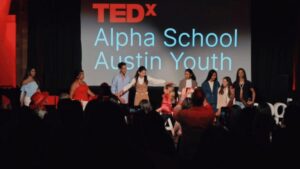
Students spend 7 weeks studying improv and sketch comedy, then write, direct, and perform their own full sketch show in front of a live audience of 100+ people. Think Saturday Night Live, but the cast is in 5th grade.
Polite Society (K–1st Grade)
Kindergartners and 1st graders learn to introduce themselves, make eye contact, and hold a conversation with someone new. The Test2Pass: walk into a restaurant independently, request a table, and speak directly to a server to order their own meal.

Climb Quest 2.0 (K–1st Grade)
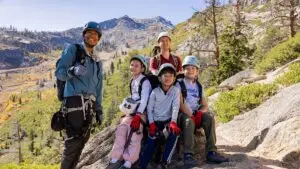
Students train at a local climbing gym over several weeks, building the physical skills, mental resilience, and daily habits to work toward a concrete goal. For kids new to the program, the Test2Pass is simple: climb a 40-foot rock wall on their own.
These are just six of the eighteen workshops our kids completed this session. From grit to financial literacy, from public speaking to entrepreneurship, every workshop is a real experience with real stakes.
What always gets me is how capable these kids are when we actually give them something real to do. These are skills most of us were never explicitly taught. We picked them up slowly (sometimes painfully), well into adulthood. The whole idea behind these workshops is to give kids a head start, to let them practice the hard stuff in a supported environment while they’re young enough that failure doesn’t cost them much, but the lessons stick for life.
If you’re a parent looking to reinforce these things at home, the simplest thing you can do is let your kids do more. Let them order at restaurants. Let them figure out how much something costs and whether they can afford it. Let them navigate an uncomfortable conversation instead of stepping in. Every small moment of real-world responsibility is practice.
Thank you for being here and for caring about this as much as I do.
Which of these workshops would your kid have loved at their age?

The Full Session 3 Workshop List
Middle School
1. Feedback Factory (Life Skill: Receive Feedback)
Students design and build large-scale fine art installations (think stained glass panels, hanging mobiles, and life-sized sculptures) using professional fabrication tools. They go through multiple rounds of critique from real artists and must document every revision. The final piece is submitted for public display at a local gallery or business.
2. Speak and Lead (Life Skill: Public Speaking / Socialization)
Students practice real-world communication through a series of challenges with peers, adults, and community organizations. The workshop culminates in students appearing on a local news segment to advocate for a cause alongside an external peer.
3. Street Speak (Life Skill: Public Speaking / Critical Thinking)
Students sharpen their interviewing skills through tiered practice sessions, then take those skills into the real world by interviewing strangers at local events. Their final interview is evaluated by a customized GPT for quality, confidence, and communication.
4. Feedback in Motion (Life Skill: Receive Feedback / Grit)
Using sports as the training ground, students practice receiving live coaching and immediately applying it under pressure. The session wraps with a Coachability Combine: an external evaluation of how well each student absorbs and acts on feedback in real time.
5. ROI 2 (Life Skill: Entrepreneurship / Branding & Marketing)
Students run a real business. They cold-call local establishments, pitch partnerships, negotiate terms, and execute live sales. The goal: recoup a $1,500 investment and walk away with $1,000 in profit.
6. Iteropolis pt. 3 (Life Skill: Learn2Learn / Critical Thinking)
The final chapter of a multi-session engineering series. Students wrap up their Future City Competition models, then create a viral-style teaching video explaining what they built and what they’d change. Both the script and the final video are evaluated by AI and a panel of engineering judges.
Level 2: 4th & 5th Grade
7. Right2Ride (Life Skill: Learn2Learn / Grit)
Students learn to snowboard from scratch over 7 weeks. And the Test2Pass isn’t in a classroom…it’s on a mountain. Kids who put in the work earn a spot on an out-of-state snowboarding trip and must complete a full run independently when they get there.
8. Alpha Afternoon Live (Life Skill: Public Speaking / Audience Engagement)
Students spend 7 weeks studying improv and sketch comedy, then write, direct, and perform their own full sketch show in front of a live audience of 100+ people. Think Saturday Night Live, but the cast is in 5th grade.
9. Building the Band (Life Skill: Become an Expert / Deliberate Practice)
Each student picks a single instrument or vocal role and spends 7 weeks becoming a specialist. The workshop ends with a live band performance where every member has to demonstrate technical proficiency, musical cohesion, and stage presence.
10. Alpha City Limits (Life Skill: Entrepreneurship / Implementing Feedback)
Students run a real band management company and plan an actual live music event — handling logistics, marketing, and event coordination from start to finish. They receive feedback from mentors throughout and have to show how they used it.
Level 1: 2nd & 3rd Grade
11. Make It. Price It. Prove It. (Life Skill: Financial Literacy / Entrepreneurship)
Students design, brand, and 3D print original products, then sell them at a real community market. To pass, they have to stand behind a booth and defend their pricing, costs, and profit decisions in a live conversation with an adult customer.
12. Sky Lab (Life Skill: Become an Expert / Deliberate Practice)
Students train as junior pilots, learning to plan and fly missions on a Microsoft flight simulator. Each week they tackle new adaptive challenges and have to explain the reasoning behind every decision they make mid-flight.
13. Spelling Superhero Training Academy (Life Skill: Learn2Learn / Learning Strategies)
More than a spelling class…this workshop teaches kids how to learn. Using association and pictorial cues, students master 25 of the most commonly misspelled words by adults while building meta-cognitive skills they can apply across every subject.
Lower Level: Kindergarten & 1st Grade
14. Climb Quest 2.0 (Life Skill: Grit / Goal Setting)
Students train at a local climbing gym over several weeks, building physical skills, mental resilience, and the daily habits needed to reach a big goal. For kids new to the program, that goal is conquering a 40-foot rock wall on their own.
15. Solo Science (Life Skill: Independence / Independent Execution)
Students watch an expert-led science experiment once, and then have to replicate it entirely on their own, with no step-by-step guidance or adult help. Just a kid, a problem, and the confidence to figure it out.
16. Polite Society (Life Skill: Socialization / Speaking to Someone New)
Kindergartners and 1st graders learn to introduce themselves, make eye contact, and hold a conversation with someone they’ve never met. The Test2Pass: walk into a restaurant, request a table, and order their own meal by speaking directly to the server.
Pre-K
17. Living Storybook (Life Skill: Public Speaking / Vocal Projection)
Pre-K students step into the characters of classic fables and perform them out loud. Using a pre-written script, they practice projecting their voice, making eye contact with the audience, and cutting down on filler words, helping them build the foundation of confident public speaking at age 4 and 5.
18. Stick-With-It Summit (Life Skill: Grit / Emotional Regulation)
Students become climbers on a legendary mountain where the goal isn’t speed, but persistence. Through age-appropriate challenges like solving a 2×2 Rubik’s Cube, Pre-K students practice recognizing their frustration, regulating it, and keeping going anyway.