Today, I’m sharing an essay written by an Alpha NYC parent, David Slifka, on how to decide if Alpha is right for your family. The Slifkas are one of our Founding Families, meaning they were one of the first 25 families to join a new Alpha campus, and they have a pair of middle-school twins at Alpha NYC. From day one, they’ve held a deep belief in Alpha’s core values, and David gives excellent, honest insight into what the school experience is actually like.
If you scroll to the bottom, you’ll find a list of resources and questions that every parent should talk through before making a decision. Happy reading!
— MacKenzie


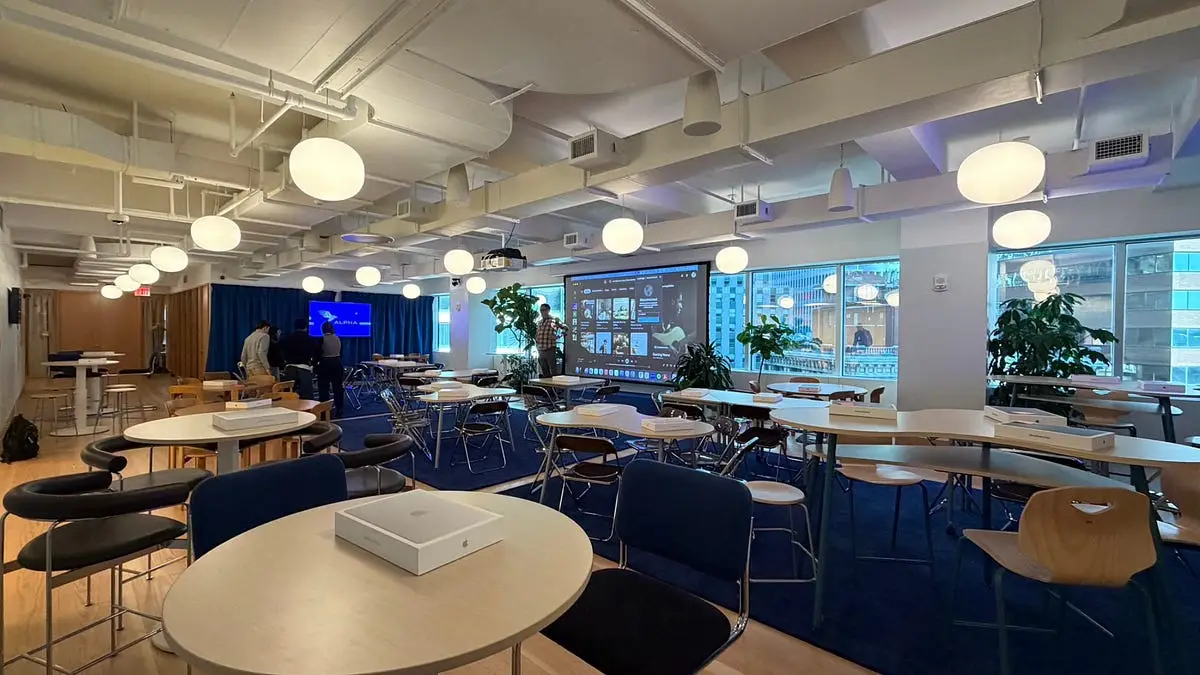
Some photos of Alpha NYC — courtesy of Nat Eliason
Why our family loves Alpha School
The good, the bad(ish), and how to decide for your child
Alpha School fulfills its promises: Kids do all of their academic work in the morning, spend the afternoon on life skills, and enjoy school.
Our whole family, both parents and kids, would be crushed to return to regular school. All of us are deeply grateful to the Alpha team for what they’ve created; both for the difference it’s made for our kids as individuals, and for our family life.
Parents sharing thoughts online was a big part of our decision to send our kids to Alpha. To pay that forward, I’m sharing my own.
Background
For those not familiar with Alpha School, here’s how I’ve had the best success at describing it.
Alpha students finish all their academics in the morning, which is possible because each child uses a laptop to receive lessons precisely targeted at the child’s level in each subject. To figure out what each student needs to learn, Alpha administers a nationally-used standardized test plus some more granular state tests.
To picture the lessons, imagine breaking down each grade level into discrete lessons of ~20 minutes each. Where Alpha finds a great off-the-shelf program like MathAcademy to teach that material, it uses that program. If Alpha doesn’t like the existing options, it creates its own.
Our twins were among the ~20 students enrolled at Alpha NYC when it opened in September 2025. Our children are in middle school, so I have limited first-hand knowledge of offerings for younger kids, and no first-hand knowledge of high school (which doesn’t yet exist at Alpha NYC).
Social proof
All the families I know are having a great experience so far, and I’m not aware of any having a bad one. Among the ~20 day-one families, three have already enrolled a second child at Alpha, which I consider a very strong signal. Alpha NYC has attracted parents who could send their children to any school in the city, and a few who could send their children to any school in the world.
The best things about Alpha
Alpha improves every part of our kids’ days.
Mornings: Academics
Each day, Alpha students log in and see a menu of lessons they can take. They choose the sequence of topics. If they have questions or get stuck, they can ask a guide (Alpha’s term for teacher), use the internet, or book a “coaching call” with a member of Alpha’s Academics Team.
Alpha’s academic model works well for our kids but in very different ways:
- Before Alpha, our son had been very distracted in class, particularly by other kids. Alpha lets him focus on his work. Sometimes he enjoys working ahead, which he can do seamlessly.
- Like most children arriving at Alpha, our daughter has some academic gaps. In traditional school, she’d keep marching forward nonetheless; but keeping pace would get harder and harder, and ultimately she’d have to address those gaps with a tutor outside of school hours. Alpha has identified these gaps and lets her address them through schoolwork.
Another benefit for our kids is that in-school learning is very active. Their prior school had a frontal learning style that didn’t work well for our kids. At Alpha, each day students are meant to “fill their rings,” just like the rings on an Apple Watch. Students fill rings by completing lessons. If a student is struggling with the material or with their work habits, it shows up immediately.
Our kids largely enjoy Alpha’s academics. Our son is mostly happy to do some at home, and sometimes even prefers Alpha work to other activities. Our daughter enjoys Alpha’s academics more than traditional schoolwork, which is a great step forward although below the high bar that Alpha is aiming for.
It’s too soon for us to know the bottom-line results. That said, Alpha’s system provides much more transparency into our kids’ progress than traditional school. Similarly, the precision and transparency of Alpha’s system lets us see educational gaps being addressed and extrapolates students’ paths forward.
Afternoons: Life Skills Workshops
Finishing academics in the morning leaves the afternoon open for cool projects that teach life skills. Some that we’ve seen in New York so far:
- Giving and receiving feedback. Kids learn the characteristics of good feedback, and make an art project to practice giving, and receiving, and incorporating feedback.
- Social skills. Young kids learn to call a friend’s parent, schedule a playdate, and send a thank-you note.
- Public speaking. Kids pick a museum and give a tour of some objects there. Combines research, public speaking, and learning about local cultural opportunities.
- Self-learning. Kids got a Rubik’s cube and had to learn to solve it by using the internet.1
Once you see these skills being taught in school, it quickly seems strange that other schools don’t explicitly teach them.
A cool but less-discussed part of the “life skills” workshops is that they all come with some kind of concrete deliverable or measurement, which is displayed at a “AlphaTest” event every ~six weeks. The concrete deliverables provide a good discipline for learning soft skills, and lets the kids see and be motivated by their progress. Plus the event is a fun opportunity for kids to present their work product to the full parent community.
Evenings: Homework
Homework is entirely different and better at Alpha. Before enrolling I knew that Alpha made homework optional, but I didn’t realize that this only scratched the surface of the benefits. The key is that rather than specific assignments, homework at Alpha is just the kids logging in and doing lessons, the same as they’d do at school. This unlocks some big improvements:
- Weeknights can be what you want. Before, homework and afterschool activities had crowded out any time for us to be a family or for our kids to be kids. Changing that has been great.
- Homework can be time-boxed. Before, we never knew how long homework would take to complete; we also never knew how much support we’d have to give, or how much cajoling we’d have to do. At Alpha, you can decide how long homework will take.
- Homework flexes automatically around other obligations. For example, it’s no problem if certain days are extra-packed with activities, or if a special event is happening on a school night. You can just skip homework that night.
- Kids can work ahead if they want to. Over winter break, our son found himself enjoying his math lessons and wanted to keep doing them. When such a happy moment strikes, students can work ahead without needing any support.
Other cool things about Alpha
Cool thing #1: Incentives
“Alpha School isn’t really about AI. It’s about systems design — structure, autonomy, measurable feedback loops, and a currency that makes achievement feel meaningful” – Rui Ma
Edward Nevraumont covers Alpha’s incentive programs well, and Alpha has a good summary of its own. So I won’t go into details here, except to say that the systems have mostly worked for our kids.
Cool thing #2: guides and Report Cards
I’ve received lots of report cards for my children, but I’ve never gotten one where teachers self-report on their own success. Alpha’s “Session Snapshots”2 include self-reports from their guide on items such as these:
- I know what makes this student ‘tickʼ and can motivate them to do hard things.
- I know the studentʼs confidence anchors and can engineer wins when theyʼre stuck.
- I have developed a strong relationship with this student where they view me as their trusted adult helping them achieve their goals.
These metrics help explain why Alpha uses the term guide instead of Teacher:
At Alpha School, teachers shift from traditional roles like grading and writing lesson plans, to supporting students’ emotional and motivational needs and teaching life skills. This impactful transformation frees up teachers to mentor, motivate, and coach students to become self-driven learners.
As an aside, Alpha has been controversial for “replacing teachers with AI.” From the inside, this concern is bizarre. Adults at Alpha are just as important and just as present as in other schools.
Cool thing #3: Growth Mindset
Alpha’s mascot is Steve the Yet Yeti, as in “I can’t do this yet.” The school puts a lot of emphasis on growth mindset: The importance of feedback, failure as fuel rather than a setback, etc. Our kids like Steve so much that they wanted one to have at home. Adding “yet” and other growth mindset terms to our family lexicon has been a pleasure. There are some secondary mascots such as Indy Pendy (the independence eagle) and Upliftapus (an octopus who uplifts others).

Cool thing #4: Socializing
With most of the morning spent on computers, I’m often asked if Alpha has less socializing than other schools. For our kids at least, Alpha’s social learning is more valuable than what happens in a traditional school.
In terms of unstructured social time, Alpha is about the same as other schools; there’s lunch, recess or physical activity, and breaks between classes.
Alpha’s structured social opportunities have some pros and cons versus traditional schools. Alpha engages students more than a typical school; for example, each week there are two town halls where students debate and vote on various school decisions. At each day’s closing meeting, students give shout-outs to anyone who demonstrated Alpha’s core values that day. On the downside, Alpha doesn’t have (for example) a literature class where everyone reads the same text and discusses it.
Some afternoon workshops involve a lot of interaction. These include traditional group projects where students make things together; in others, students explicitly learn social skills like giving and receiving feedback, or interacting with strangers.3 Social skills are also required to advance in grade level, because students have to complete various tasks such as:
- Join an external club in your community that has at least 10 members. Attend at least 3 meetings.
- Identify a ballot or initiative you support. Educate and inform an audience and gain at least 20 signatures.
My worst complaints about Alpha
Prospective parents always ask me what has been bad so far. It’s a very fair question but I struggle for an answer; there’s been nothing that I’d call “bad.” But I wouldn’t ask anyone to trust my thoughts if all I share is glowing praise. So here are all of my criticisms, mild as they may be.
1. Startup Frictions
All schools have some communication hiccups and other little inconveniences, and so does Alpha; all such issues at Alpha have been well within the norm of our past schools. The primary issues we’ve run into so far feel like inevitable frictions when building something new. These mostly manifest as imperfect communication, for example:
- The incentive systems definitely work overall, but there are several of them and neither we nor our kids always understand or remember them all.4
- Earlier in the year it was sometimes unclear what the afternoon workshops were and what the deliverables would be, but this is already improved.
- Shortly before the school year started, a one-week break was removed from the calendar.5
- Details of events sometimes weren’t announced until shortly beforehand.
Another example of building the plane while flying it is that Alpha rebuilt their software this past summer, and the new version is still being completed and refined. The new version doesn’t yet have a parent dashboard; we can log into the student interface and follow along in some subjects, but not others. The system gives us much more visibility into academic progress than traditional school, but much less than is possible given Alpha’s wealth of data. Also, some interface confusion slightly delayed our daughter taking some tests; we heard that’s getting fixed for all users.
The biggest unknown is whether Alpha can maintain its high standards while growing so quickly. Growing anything from the current 30-ish students to 100+ is challenging. Alpha is trying to do that in multiple cities at once, while also still developing its core offering. I understand that decision; Alpha has a great product that will improve the lives of countless kids, and it wants to achieve that as quickly as possible. Meanwhile each parent cares primarily about their own child’s experience. Balancing that tension is a challenge that Alpha is aware of, and we’re rooting for their success in managing it.
2. Enrichment classes
Alpha NYC doesn’t have typical enrichment classes such as Music or Art. This is an area where Alpha is different from traditional school but not necessarily worse. It’s easy to look at what Alpha has removed from traditional schooling; before passing judgment, you have to weigh the removals against what’s been added.
In our experience, Alpha teaches humanities mostly as a vehicle for learning life skills. For example, our kids painted pointillist images as a vehicle for learning how to give and receive good feedback. Their study of pointillism was more cursory than they’d get in a traditional middle-school art class; in exchange, they learned the life skill of giving and receiving feedback. To me that’s a great trade. Similarly, they learned research and public speaking by preparing and giving a tour of a local museum. The several afternoons they spent touring museums don’t fit neatly into a box called “art class,” but they’re not nothing. To me, the only clear loss in this area is the ability to synchronize material across classes, for example studying American History as a theme across English, social studies, and art.
If you start from first principles, what makes the most sense to teach in school versus outside? I’d like for my children to have exposure to art and music, but that’s mostly achievable through extracurriculars and family cultural experiences, particularly given that homework is optional. We’d have a much harder time finding ways to teach our children the life skills that Alpha provides.
3. Marketing language
Some of Alpha’s marketing language confused me, and I find it confuses others as well. I understood Alpha much better once I figured out the following:
- AI Tutor? Alpha self-describes as having an “AI tutor,” but kids never use an AI chatbot as a tutor. By “AI tutor” Alpha is mostly describing the software that analyzes a student’s performance and decides what lessons they should take next. It clicked for me when Edward Nevraumont wrote that the AI “is closer to ‘turbocharged spreadsheet checklist with a spaced‑repetition algorithm.’” That said, there is AI feedback on student writing.
- 2x Learning? The 2x claim wasn’t important to us, because it’s an epic leap forward to achieve just “1x learning” (finishing a full day’s academics in just the morning). It’s too soon for us to say if our kids are learning twice as fast as regular school. A happy-but-former Alpha parent says that the 2x claim rests on bad statistics. The 2x claim doesn’t mean that a typical Alpha 6th grader will have finished a high school curriculum, making it rather non-intuitive.
- Two hour learning? The two hours is just focused time, meaning that it excludes breaks. Rather than “two hours,” I describe Alpha as doing all the academics in the morning. School starts at 8:30, and by 11:45 all of the kids have moved on to lunch. The rest of the time is a fun morning “launch” activity and breaks.
Putting it Together: An “Only-at-Alpha” Story
Our daughter had an experience that highlights the pros and cons of being at a school on the frontier of using AI.
One of her assignments was to summarize a passage with a paragraph of the form (topic sentence → 2-3 supporting details → concluding sentence). The passage was a narrated recipe for making cinnamon rolls, and the question was “How do you prepare cinnamon rolls before baking them in the oven?”6
A human would have quickly noticed that a structured paragraph is not how to write a recipe. The AI tutor gave feedback incongruous with the assignment, telling her that she had left out some of the steps or ingredients, and rejecting topic or concluding sentences without recipe-specific content. She was a good sport about the whole thing, but it led to some wasted time and frustration (including from me and my wife).
At 7:34pm, I shared the issue with her guide. In the next 12½ hours, the following happened:
- The guide forwarded the issue to Alpha’s Head of Academics
- The Head of Academics sent it to the “AI-Driven English/Language Arts Learning Strategist”
- That person sent us a fulsome response, explained how our daughter could get a different passage, and shared the issue with the development team.
This story illustrates the tradeoffs of being on the cutting edge. On one hand, our family encountered some frustration and wasted time. If our daughter hadn’t raised the issue and/or no adult had caught it, then it might have lasted longer. On the other hand, our daughter learned lessons about being willing to question assignments and what it looks like to build things in the real world. Alpha parents are the type who are happy with that deal.
Resources to help you decide
Would Alpha be a good fit for your family? The best way to decide is to send your child for a shadow day. The first step is to attend an info session, which you can find here.
In the meantime, here are some good resources to learn more:
- This essay by Edward Nevraumont was extremely helpful to us in our learning and decision process. It’s long but very worthwhile to understand Alpha as well as the science behind it.
- Zvi Moshowitz describes some of the science behind Alpha.
- If you prefer podcasts, this one with Alpha’s principal and major backer Joe Liemandt is a great overview and sparked a lot of interest.
- I also read a negative piece by a former Alpha Brownsville parent. I’m relieved that our experience has been very different from hers. Perhaps Alpha has learned from the issues she describes, and we are the beneficiaries of that improvement. (Notably, all current Alpha Brownsville parents have signed on to a letter saying they’re happy with the school.)
Some questions for prospective parents to consider:
- Does your child enjoy school? If not, how different would your life be if they did?
- Is your child successful in school? If so, does that success come at an acceptable cost to their time and mental health, and your shared family life?
- Is school using your child’s time productively, both in school and via homework?
- How much do you need to supplement the learning your child receives at school, with your own time or with tutors?
If I were a prospective parent, I’d take a lot of comfort that among the ~20 day-one NYC families, three have already enrolled a second child at Alpha. The families who have seen it up close are giving the ultimate vote of confidence.
Conclusion
Alpha promises that kids will love school. Our kids are not quite there yet but are very close, which already feels miraculous. Occasionally our kids blurt out things such as “I like Alpha 20 times more than my other schools.” Obviously that’s a joy for any parent to hear. So many of Alpha’s improvements would be amazing on their own, and getting them all as a package is transformative. The future of education will look more like Alpha than traditional school, and we’re excited that our children get to be among the first to experience it.