Millions of kids love sports. They live for the competition, the movement, the teamwork, the pursuit of something they’re actually excited about. Many of them are dreaming about taking their sport to the next level and going D1.
So, what if we took this passion and applied it to the classroom?
Tell an 11-year-old that public speaking is a valuable life skill and they’re going to (surprise!) roll their eyes. But when you talk to them about speaking in a post-game press conference, their eyes light up.
Tell a 12-year-old they need to learn financial literacy and they’ll tune out. You’ve lost ‘em. But if you ask them, “Ready to negotiate your NIL contract?” all of a sudden, they’re pumped.
The lens through which a kid learns determines how efficiently they learn. When the context connects to something they care about, their ears perk up and their effort spikes.
We kept asking ourselves: what would happen if we built an entire school around that idea?
And so, Texas Sports Academy was born.
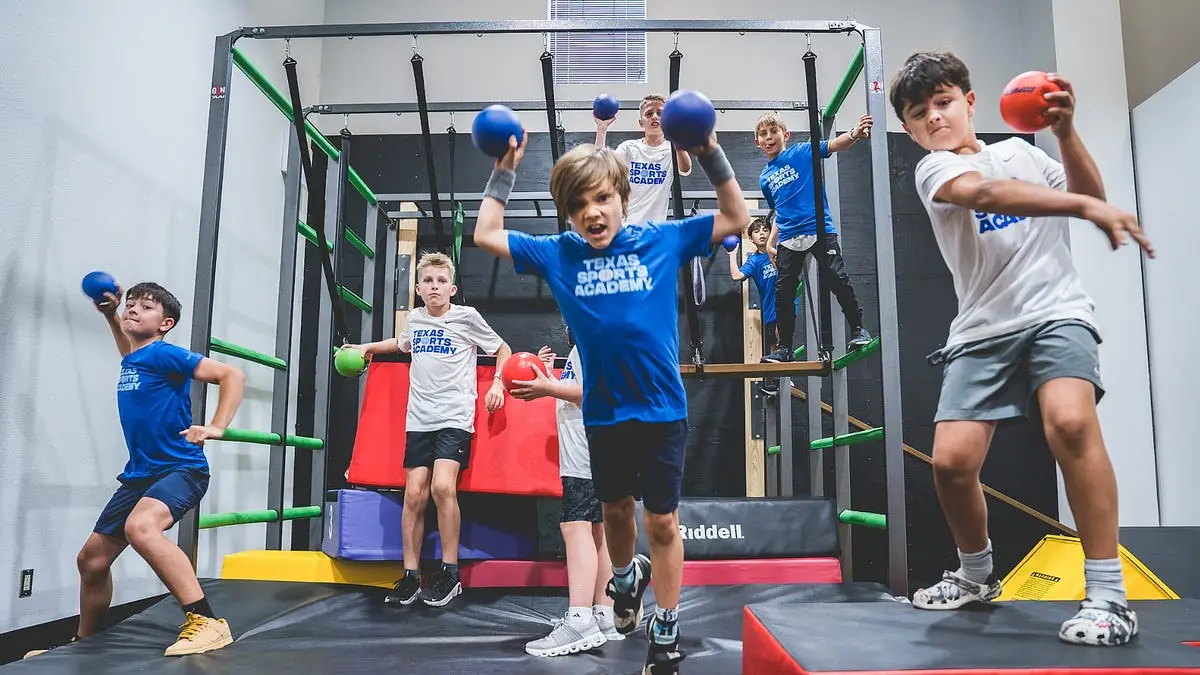
Texas Sports Academy: where D1-aspirational athletes master academics and athletics
Texas Sports Academy follows the same academic model as our Alpha schools (two hours of academics in the morning, four hours of life skills in the afternoon) except everything at TSA runs through the lens of doubling your kid’s D1 odds.
The post-game press conference and NIL contract examples from earlier? Those are actual workshops that kids take at TSA. (How freakin’ fun is that!?)
What’s even cooler is that academics and athletics compete for the same energy. For example, kids who top the academic leaderboard unlock the Dr. Dish machine, one of the most coveted pieces of training equipment in the building. What happens in the classroom directly affects what happens on the court, which merges the ethos of athletic rigor with academic excellence.

In my last essay, I wrote about why sports are superior at building life skills:
-
Individualized attention
-
High standards
-
Genuine responsibility
-
And mastery before advancement.
At TSA, these principles are implemented all day, every day, across both academics and athletics. And the coaches implementing these principles have competed at the highest levels possible.
The most elite coaching in the country
We have former MLB players, NBA players, and U.S. Marines who motivate and mentor these kids every single day.
Graham Spraker played for the Blue Jays and the Rays. Jermaine O’Neal spent eighteen years with the Pacers and Trail Blazers. Kelvin Childress is a Marine Corps veteran who has studied education systems across three continents and now leads TSA’s flagship campus.
These are the guides sharing their expertise and coaching kids to success each day.
Younger levels (K-5) focus more on things like athletic movement, coachability, and teamwork. The older levels (middle school and up) are where kids begin to specialize in certain sports. This is where D1-aspirational kids really thrive. They get to master academics in the morning, then spend the afternoon honing their specific craft and learning awesome life skills along the way.

This model works for any kid, any passion, any niche
I think what’s most exciting about this model of education isn’t necessarily what it does for athletes, but what it says about education more broadly.
The model that Texas Sports Academy runs on isn’t specific to sports. It can be tailored to any student, any passion, any niche.
For instance, Alpha School prioritizes tech and entrepreneurship. Texas Sports Academy is all about sports and doubling your kid’s D1 odds. We have another school called NextGen Academy that focuses on gaming and eSports. G.T. School is designed specifically for gifted and talented learners. Waypoint Academy (which just launched in Dripping Springs, Texas) emphasizes survival skills and wilderness training.
The list could go on and on.
If kids learn best through the lens of their passions (they do), then there are infinite lenses through which we can tailor learning.

What this means for your kid
This model of education, called TimeBack, offers something different for your family than the decades-old hum-drum of standardized schooling.
If you want to get involved, you can enroll in one of our existing schools, or you can implement this model at home. You can even start gathering like-minded families and start your own school, choosing whichever lens you like.
Historically, traditional schools have handed every kid the same pair of glasses, forcing every kid to view education through the same lens.
But what if the lens itself is the variable?
What if instead of asking your kid to fit the model, you simply choose the model that fits your kid?
If you could build a school around your kid’s passion, what would it look like?